Showing posts with label J W Marasinghe. Show all posts

Saturday, December 24, 2022

J W Marasinghe; the Man for All Seasons at Gurutalawa


John William Marasinghe

The Hayman Era (1942–1963) is said to be the most prosperous period at S Thomas' College Gurutalawa. But tradition prevailed, thanks to a team of staff that took on the challenge of running the school in line with Dr Hayman’s ideals even after his retirement in 1963. The new Headmaster was Canon A J Foster. However, it was so unfortunate that he too passed away the following year bringing in a vacuum that raised concerns about the future of the school. The challenge now came upon a team of dedicated staff headed by Mr Kilto Chapman a pioneering old boy with other support staff; J de S Jayasinghe (Uncle J), M Chinnaiah, Selwyn Goonewardene, Oliver de Soyza, Lucian Amarasinghe all who devoted their life and time to the school.   Among them, there was one person, who was also an old boy who left college in 1954 and joined the administrative staff in 1957. as Dr Hayman’s secretary and did continue in the position as the Office/Headmaster’s Secretary.

Mr John W Marasinghe; was a chubby, curvy, and cherubic character. He was Billy Bunter at school. (The famous fictional chubby schoolboy character that appeared in a series of schoolboy novels, comic strips and a television serial then.) Mr Peter Weerakoon (brother of Bradman Weerakoon) reminisces about his contemporaries from 1947 to 1952 highlighting the train journey from Colombo to Nanuoya. 

“Those were the halcyon days of yore. The term would start with the boys from Colombo and beyond meeting on Platform 7 of the Colombo Fort Railway Station to take the Up Country Day Train. Besides the crying and the sad goodbyes to parents, there would also be a sense of joy and happiness of meeting up with old friends, whom I recall were L.M.Fernando, Majintha Perera, Nicky Rose, Micheal Silva, Bandu Wanigasekera, V V Vandersmaght, John (Billy Bunter) Marasinghe, Peter Ondaatjee, John de Vos and the two boxers, Joe “Louie” Somasunderam and D.G. Welaratne.”

Mr Marasinghe entered Gurutalawa in January 1948 as a student after completing his prep schooling at Kollupitiya (there had been students from Kollupitiya coming over even earlier). He left college in 1954 and later joined the staff in 1957, just as Mr Chapman and Mr Laffir did in their nominated positions fulfilling the wishes of Dr Hayman and Fr Foster. 

Mr Marasinghe was not on the tutorial staff but was very much the main administrator in running the school office for Dr Hayman. He managed the small office with Mr Benjamin Fernando as the Bursar Mr Patrick Phillips (Clerk), Mr Nadaraj (Bookkeeper/Pocket-money man) and Bernard the Peon. Together they managed the communications, linking the parents and the school while maintaining the required confidentiality and the safety of the academic activity in conducting term-end examinations etc. All the test papers were hand stencilled by subject teachers and the English paper was stencilled on the typewriter by Mr Marasinghe himself. Then the paper would be copied in the required number in a hand-operated Roneo Printer all by himself and packeted and security sealed for storage until the day of the examination when they would be handed to the relevant invigilating staff. This was done in such an efficient manner and never in the history of the school had had any record of an examination paper being leaked before the day or a repetition of a paper.

Though his main application and occupation were in the running of the college office he was multifaceted when it came to extracurricular activities and swimming. He was the Chief Scouter of the 3rd Nuwara Eliya Troop, Master in Charge of Swimming in general which included coaching the college team. He continued the Birdwatching Club started by Rev Canon A J Foster. He continued the screening of the film shows which was Dr Hayman’s undertaking before. Further, he was the house master of the Keble Dormitory; a subsidiary facility where boys were offered accommodation when the selective Junior and Senior House dorms became full. Outside these activities, he was a different personality with a multitude of hobbies be it music, photography, drama, snipe shooting, stamp collecting and indoor games like scrabble and card playing.

Scouting

Scouting at Gurutalawa has always been special and unique from the early days. Conducted under the guidance of Dr Hayman who was the first Scout Master and later under Mr John Marasinghe and Rev Fr Harold Goodchild after Dr Hayman retired in 1963. Mr Marasinghe in his account about scouting at Gurutalawa from 1942 -1990 in the First 50 years records; … “Scouting started initially with the first Troop Meeting held on 20th May 1942 a very few days after the Gurutalawa branch was started. Therefore, it would be correct to say that Scouting was the first organized extra-curricular activity at Gurutalawa.”

It is noted that Dr Hayman continued recording in the Troop Logbook of – 16th (S Thomas’ College) Colombo which hints that he oversaw the Scout Troop at Mt Lavinia started in 1935 and retained the Logbook to continue with the 5th Badulla Troop at S Thomas’ College Gurutalawa. It was a different type of scouting to which the Colombo-educated scouts had been accustomed when compared to outbound  Gurutalawa.

Scouting was very popular among the students from the early days and there were Mr Habaragoda and Mr Pillai who helped Dr Hayman with the troop and other activities. By 1950 there was a need to start a sub-junior troop as the numbers increased among the juniors. However, it is noted by the end of 1950 all the support staff had left and Dr Hayman was running all three troops. But this was resolved with the senior scouts assisting him with the juniors and sub juniors assisted by the juniors.  When camping came up staff members visited the camps for assistance.

Mr Marasinghe records his initial involvement with the school; thus, “I had left college as a student at the end of 1954 and in July 1957 I re-joined, but this time as a member of the staff. One of the first things I was asked to do was to organize the Senior Scout Camp. This was a new experience to me but thanks to the staff and the scouts alike it turned out to be a memorable one at Buttala in Monaragala.”

When I joined in 1967 the troop was under Fr Goodchild and Mr Marasinghe and scouting restarted for the juniors after a lapse when the few senior scouts functioned under Fr Goodchild. The senior troop however ceased by 1968 and the junior troop flourished under a new registration as the 3rd Nuwara Eliya Group.

Both Fr Goodchild and Mr Marasinghe had achieved their Wood badge and the Bushman’s thong the highest awards for Scouters then. The camps in the outstations Batticaloa, Lahugala, and Yala were of very high standard. Many students turned out to be first-class scouts and a few went up to achieve the President’s scout badge by 1972.

I remember my 1st Class hike with the late Senaka Ratnayake which Mr Marasinghe had mapped for us. We were to hike from College to Ohiya .. pitch camp for the night opposite the Ohiya railway station and on day two traverse the bridal path up on the hillside laid parallel to the railway line to Idalgashinna. From Idalgashinna we went direct to Rathkarawwa as given on the one-inch map all the way down passing Anura & Srinath Dissanayake’s home and Sarath Weerasekara’s home on to the Haputale Boralanda Welimada road leading to college. I now understand that this was the same route that Dr Hayman had once plotted for M Rajagopal and Akram Suby much earlier. However, I must confess that at age 14 this was quite a tough walk with a backpack full of provisions, cooking utensils, a canvas tent and ground sheet a hand axe; a weight of approximately  20 lbs. on your back. That was the toughness of scouting at Gurutalawa even by 1970. We were so tired walking to college in the last lap when the bus from Haputale to Welimada stopped for us and the conductor mistook us for service personnel and offered to take us wherever we intended to. We did not disappoint the bus crew but rode in it up to Boralanda and walked the balance distance to college. Yes…. this part was omitted in the Hike Report for obvious reasons.

The Scout troop has continued to maintain excellent standards all these years, and in 1983 the troops recorded the largest number of First Class Scouts. The legacy left behind by Dr Hayman did continue.


Scout camp in Palatupana Yala 1969


Scouting in the Hayman Era


Author with Ratnayake cousins (MBR, HR, author & late SR)

Author's 1st Class Investiture

Scout Troop with Dr Hayman,  (first visit  1970)

Swimming

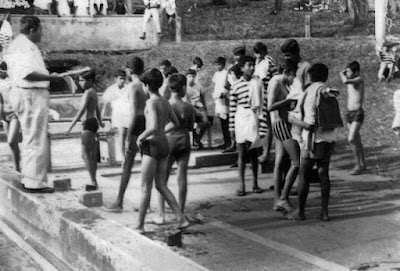
Swimming again was under Dr Hayman at the beginning and it was to Mr Marasinghe that he entrusted to continue with after he left in 1963. However, Mr Marasinghe notes that he was also a member of the college swimming team up to 1957 and later oversaw swimming. He was a member of the first-ever swimming team that entered the Public Schools Championship in 1952. Seven swimmers comprised the team D D Wickramanayake, J W Marasinghe, D J Templeman Kluit, J Livery, T Mitchell, A J Robb and A W Senanayake. Competition in Colombo then was limited to St Josephs and S Thomas’ Mt Lavinia, and we were not up to the level of competing with these schools until 1962. In 1962 college had a super team that could compete with any Colombo school and Mr Marasinghe records the performance, “In early March 1963 we entered for Novices Meet and all those who were showing promise did well. We obtained 3-first places, 7-second places, and 2-third places and shortly after this meet Dr & Mrs Hayman left S.T.C.G. for England for their retirement. It could be said that it was the end of an Era.”

Again by 1969, we had a promising team that included me trained and coached under Mr Marasinghe on the U 14 and U 16 age groups. We had Alan Goodchild (nephew of Fr Goodchild), C.C Ching, M. I Rauf, E.M Jayawickrama, T U K Wijesena, and M Sritharan. The standards we rising again but not to the level in 1963/1964. In 1970 the U14 did well at the Novices Meet.

By 1975 with many of the Colombo schools being provided with the infrastructure for swimming the swimming meets were very challenging. With the school changing by 1977, the interest towards competitive swimming did fade off and is now reviving with the upgrading of the pool.

General swimming continued after school for two hours under the supervision and watchful eyes of Mr Marasinghe. Almost every boy entering Gurutalawa could not swim but was an able swimmer when he left. Mastering the art of swimming was not taught by a guide in the water unlike today but it was more of a self-learning process. We started kicking the water holding the side wall of the breadth of the pool. This way we managed to keep our lower body afloat parallel to the surface of the water. Once this was achieved, we were allowed to use our hands and explore the breadth of the pool, in a comfortable style be it Breaststroke or Free Style crawl.

Finally, one had to undergo a passing out test to venture into the deeper end of the pool. The test was to swim four (4) lengths, 100 yards nonstop alongside the long end of the pool. This was no easy task, and many did qualify only after three (3) attempts or more.

But there had been a few rescue missions performed by Mr Marasinghe on strugglers swimming the breadth of the pool. Some strayed into the mid-pool area where one couldn’t get a foothold.  I remember when M M Uvais (Bumpy) started his swimming trial across the breadth of the pool and strayed into the mid area and had had two mouthfuls; Mr Marasinghe went in lock stock and barrel clad in shoes and with pockets all full to rescue Bumpy …. However, Bumpy did end up a good swimmer and represented the college.

Dr Hayman and staff member jumping off the high board


Junior Swimmers Hayman era


Inter-house swimming meet 1969


Mr Marasinghe in his comfortable Cat's Paw slippers and short trousers conducting the  Plunge Event. author with stick in hand to mark the Plunge limit. (Pix Curtsy Jayadeva)


Birdwatching

Gurutalawa most probably is the only school that had a unique campus with orchards and treelined boundaries with large leafy canopies that attracted birds. In this special location was this ideal bird enthusiast Canon A J Foster. Gurutalawa being the first ever outbound school in the country it was Fr Foster who started a Birdwatching club and inculcated the subject of Ornithology as a hobby for those interested.

Gurutalawa during the migratory season is abundant with all the migrants that inhabit the hill country. Again, it was Mr Marasinghe who took charge of the birdwatching club after the demise of Canon Foster in 1964. The club prospered in a small way with interested boys keeping records of birds seen and identified on an annual basis. Recording the same bird revisiting the same tree in the orchard in the same week as the previous years. Boys contributed with their writeups to Nature Magazines and especially to the Loris the journal of the WNPS… the photography of birds and behaviour was recorded by Mr Marasinghe, and the binoculars and bird guides were those of Mr Marasinghe which he allowed the boys to use at any time.

There was a prize dedicated to the best birdwatching student and the first recipient of this prize is said to be Sarath Wimala Bandara Kotagama… who later made Ornithology his Profession and is today an Emeritus Professor of Environmental Sciences. He wrote to the college magazine way back when he won the birdwatching prize about his Bird book;

My book about Birds

Most of us are interested in birds.  We like to hear their cheerful songs, to see them as they fly down beautifully through the air, to watch them walk proudly on the grass or slip about bushes in search of food.  But like most wild things, birds are shy and if we wish to learn about the wonders of their lives, we must watch them patiently and quietly.

Most bird lovers keep a bird book in which to note such things as, the day when a certain bird was seen, the food it ate, it's colour and shape, the way it flew, the way it walked, when it began nesting, its song and so forth.  By keeping a bird book and making regular notes in it and perhaps drawings as well we get the greatest enjoyment from our bird-watching study.

S.Kotagama: Upper 6th, St Thomas’ College, Guruthalawa – 1966

Sarath today is an authority on the birds of Sri Lanka, and it was Mr Rohan Pethiyagoda also another eminent Thomian scientist who said; talking about the Birds of Sri Lanka one needs to talk of the period before Kotagama and after Kotagama

During a birdwatching session (Pix Curtsy Jayadeva)

Film Shows

Film shows in boarding schools were quite a common feature then. I remember that even while at the Prep School Bandarawela we were entertained by a film show about once a month. These were 16mm films imported into the country by Ceylon Theaters Ltd and other such movie companies. The films were mainly Western movies with famous actors Jean Autry, and John Wayne to even classics like ‘Count of Montecristo’, and ‘It’s in the Air’ a comedy, which was some of the most famous films among us boys then. I remember we would have seen the same film five times during our stay in school. That’s once every year as there was a restriction on films imported into the country; they repeated the films.

The school had a 16 mm projector, again a personal gift from Dr Hayman who was a keen cinematographer shooting his own 8 mm films of all the college activities and scout camps in the outstations. He would then screen these at the OBA etc.

However, when Dr Hayman left in 1963, he entrusted the screening of films also to Mr Marasinghe, an after-dinner speciality that came up suddenly. The small windowpane above the office counter displayed a small note in Mr Marasinghe’s handwriting – “Tonight’s Show – It’s in the Air”.  Like Dr Hayman, Mr Marasinghe also loved photography and cinematography and many boys also showed a liking for these hobbies and assisted them during these shows in spooling the film to an empty spool to be returned to the agency.

A boy who assisted Dr Hayman then was Mr Chandran Ratnam who later made films his career in life. Gurutalawa, therefore, has moulded people outside of the curriculum who become authorities in their likings and hobbies.

House Master of Keble Dormitory

Keble Dormitory was the furthest located unit of the school away from all other facilities down in the far southeastern end of the campus. Today the junior school is in that area and is a different setup altogether. When all other dormitories were categorized under Senior and Junior Houses, De Saram, Garnier and Read so named after the Bishops, but Keble dorm was for all houses named after the founder Headmaster of the Prep school at Bandarawela. Generally, one would be going to the Senior dormitory from Keble when a vacancy was available. But many of us did continue our entire stay at Keble and I was one. It was an old house turned into a dormitory with bunk beds arranged within the rooms and the sitting areas, unlike the normal ward-type arrangement.

Mr Marasinghe too had a separate room in the house, and a door opened to the dormitory that he used as the entrance. A rear door provided access to the back garden. The two office assistants Mr Patrick Phillips and Mr Nagaraj (Yakadaya) also lived here with the Handyman and the Orderly named Jayasundara. Jayasundara was the man to watch out for… for he sneaked and carried all the mischief to the staff that ended up with a punishment.

Life was simple while we all were involved in any activity conducted by Mr Marasinghe and room time was spent listing to Holiday Choice over his large radio set or playing scrabble or 304 with him.

The rear part of his quarters became our kitchen at times when the stock of Ice cream and Pawkies from Elephant House came to the Coop Shop from Colombo. It was a novel way they transported the ice cream and the cold meat in a large wooden chest lined with aluminium sheets and packed with ice and salt transferred by the night train to Haputale. The ice was still hard when the chest arrived at school.

After the scout camps in the outstations, this rear part of the quarters became the darkroom when we all got together with him to develop the films and make contact prints. We learned our photography and film developing from him. He had two Twin Lens Reflex (TLR) cameras that used 110 film rolls.

And then in 1970 when Dr Hayman came back for the first time after his retirement, he brought him his first Pentax SLR camera and to develop 35mm films it had to be given out to Millers in Colombo.


Contact printing after Yala Camping trips

There were times when our pranks played on other boys went too far and we were punished just as we enjoyed staying with him. I remember once when we fixed the bucket of water for Ravi Rajendran (Ganja) to spill over when he came into the dormitory, but Ravi was delayed at the bathroom, and it was Mr Marasinghe who happen to get ducked. Even though it was not meant for him punishment was customary as the recipient was a staffer and the nature of the prank was serious to be discussed later.


I remember another incident when he had gone snipe shooting at the paddy field behind the dormitory with Mr Nadaraj assisting him in flushing the snipe for him. He had cleaned the double barrel for storage and Anura Dissanayake and I pulled the triggers just for kicks. He noted that someone had meddled with the triggers, and we had to own up only to receive three of the best and the gravity of the situation explained had the barrels been loaded.

Gurutalawa flourished during the Hayman Era and the immediate post-Hayman Era. The secret being that few teachers were devoted to the school. Among them, three were very eligible bachelors…Uncle J, Kilto Chapman and John Marasinghe. The three did produce and act in dramas with the senior boys and Uncle J produced the famous Ralahami series dramas and staged them in college and Colombo.  However, this bachelor bond was broken when Mr Chapman married Betty Chapman in 1970 and later Mr Marasinghe wedded in 1973. Uncle J continued as a bachelor all his life.

Mr Marasinghe continued to live in the Keble dormitory premises while the junior school also came up in the vicinity. Later when their daughter Shamindri was to attend school she was enrolled in the junior school as the girls of the staff members were permitted up to grade 5. When she finished her 5th year in school it was time for the family to move out of Gurutalawa. An exception was made by the board of governors permitting Shamindri to continue in college which she did from 1979 to 1989.


He was the Master in Charge of the Computer Science Society as well ..... he was ever ready to absorb new technology 

The family moved to Colombo the following year and Mr Marasinghe was now working for Douglas & Sons an enterprise of an old boy. I remember meeting him at this place once to get some photographs of Fr Foster to turn out a life-size cutout for an exhibition in Mt Lavinia. He was very helpful, and I remember him visiting the stall in Mt Lavinia.

It is so unfortunate that I did not meet him after this event as I was out of Colombo. When I took up an assignment at the BIA in Katunayake I met Mano Gnanaraj at Sri Lankan Catering, and it was he who recounted the tragic demise of this humble character in 2004. My heartfelt condolence to the family. But he for sure lives in our hearts and minds every day. 


Wednesday, September 23, 2020

‘Spare the Rod and Spoil the Child’ – Corporal Punishment?


Spare the rod and spoil the child is a famous adage appearing in the Bible and made its way into practically every proverb collection. It initially alluded to beating and is cited often but does not necessarily mean for beating in today's usage.

We who went to school before the 1980s were never spared for mischief and misconduct. Mischief and misconduct took place intentionally at times but most often one got into trouble inadvertently; feeling tolerable and be ensured to go unnoticed when in a joyful gathering. However, things never turned in support of one's self and if collective persistence was applied in protecting an individual, the result ended with the whole group being punished. 

Sadly though this is not the case today with the international human rights declarations on child rights; corporal punishment is considered as torture and legal conventions work the other way round. Most children today are overprotected and are devoid of any adventurism and has turned out to be dull fudgers in comparison to us then at school.  

S Thomas College Gurutalawa located in a 35-acre farmland was a heaven to the boarding schooler. The plentiful orchard with the seedless Golden Mandarins the rare Palestine Naval Oranges and the Japanese Persimmons was the Garden of Eden. There wasn’t any fruit named as forbidden, yet every fruit in it was marked taboo to us cohorts of Adam. A no go zone declared out of bounds. There was no Eve, for it was a boy’s school and no serpent cos the temperate climate did not favor them. However there was an orchard keeper called Goluwa, a dumb man says, Mr. Clifford Ratwatte a pioneering student, reminiscing his memories of school days. These alien exotic fruits were a temptation to defy and if seen by the Goluwa and reported to the headmaster, one ended up getting six lashes on his buttocks. This is about the earliest record of the corporal punishment conducted in this institution, established in the year 1942.

The orchard did exist even during our time in the 1960s but there was no Goluwa or any other keeper to watch our movements but the orchard was still ‘out of bounds’ and violators were the recipients of the corporal punishment.

Reprimanding and punishing mischief-makers did instill fear for misbehavior in others and thereby bring discipline and order in a school. However, there were times when things went out of hand and disciplining required spanking large groups of students. Often known as public canning where otherwise disciplining was done covertly.

I recall two such incidents during the late 60 s which today turnout to be hilarious but sure did instill fear in us then.

A rainy day in 1968. 

There was an understanding that on a rainy day evening prep from 6:40 PM to 7:30 PM would be held in the dining hall accounting for boys falling sick the following day by getting drenched in the cold weather going to the classrooms and back. Mr. Tuline Ratnam the duty master had professed for hall prep. Every activity in the school was on a time schedule communicated by Bell Simon who rang the bell by default.  However, the bell was only the communicator to start a new activity but ceasing the current activity happened only on the consent of the teacher in the class or the duty master assigned for the day.

On this particular day, the dinner bell rang at 7:30 but Mr. Tuline Ratnam the duty master did not consent for the ending of prep for some reason, and everybody remained seated. The senior boys were agitated and some started rubbing their footwear against the rough cement floor annoying Mr. Ratnam. This continued for almost ten minutes, each time Mr. Ratnam strode in one direction the boys to his rear would turn rowdy and when he turned towards them those now behind him would turn unruly. For us juniors, this became an amusement but dared not giggle for fear of being reprimanded.         

During prep time the college campus goes into a total silence until the dinner bell when a huge clatter is heard with the steel chairs pushed back followed by the chatter of the boys. But this day it was strange for the stillness to continue which aroused the concern of the headmaster Mr. Frank Jayasinghe who walked into the dining hall still in his tennis attire. He had been watching what happened from outside the dining hall and there was no necessity for owning up. His office room adjoins the dining hall and a dozen canes came into the hall.  To this day I am stunned of the stamina that Mr. Jayasinghe then in his early 30s possessed caning 56 senior boys four cuts each with twin canes. His longarm tennis swing was amply displayed in an effortless manner stopping only to change a splitting cane.

No grudges or revengeful feelings towards anybody, everyone sat for a quiet dinner under pin-drop silence. That was a classic case were the seniors thought that they could get away pranking as a group without punishment. The whole lot got punished but some would have been really innocent.  

School Assembly 

The second incident was in 1971 and is more hilarious. There were two notable brothers Desmond Miles and Gifford Miles. Desmond was a mild-mannered altar boy while Gifford the younger one was the exact opposite a mischief-maker and a terror in class.  Old Mr. Ganamuththu who took English literature would give us a piece of comprehension to work on and rest awhile in an unsuspecting manner. Gifford would note this and drop his box of mathematical instruments in a metallic clang to startle old Gananamuththu. He would then rush towards Gifford with his foot ruler to the laughter of the rest and smash Gifford’s knuckles with the ruler edge. That was Gifford.

The Headmaster was Mr. E L Perera a different type of headmaster who trusted molding children in a spiritual manner and did conduct small spells of meditation before school to different classes on a weekly routine. However, Wednesday was the general assembly day to the whole school that was held in the dining hall before the first period.

This particular Wednesday  Mr. John Marasinghe the headmaster’s secretary brought in four canes and placed them on the table before the assembly. ELP started with his routine sermons on good manners and meditation and ended with the general announcements. To our curiosity he started all over again in a harangue blasting of being ungrateful to the school of being unbecoming to one's parents, etc. and in the end called Gifford Miles to the stage….. It was a funny scene, ELP a short-statured man in his well creased Tusso coat and trouser looking up at a heavyweight Gifford.... more like  David looking at  Goliath. 

He then delivered to the assembly the reason for summoning Gifford to the stage. There was no need for Gifford to admit or confess to his misconduct for he had autographed his graffiti in the newly color-washed staff room.  Gifford had entered the staffroom after school for reasons better known to him and taken time off to draw a life-sized guitarist in a single line graffiti with charcoal and autographed it, Gifford Miles.

Gifford admitted to his fault and was caned in public at the assembly. Gifford being tall was asked to bend holding the table. Six of the best of ELP’s tennis slams ended on the back of his thighs. His bum was spared cos ELP being a short man was out of reach but Gifford had the branding on his thighs for weeks.


The  Prank that Backfired

There were other times when a prank played on another student would turn out to be a disaster calling for unexpected punishment. Such an incident took place in the Keble dormitory when we planned to play a prank on Ravi Rajendran [Ganja] who is now domiciled in Toronto Canada. Keble had the toilets as an outside block and a single one indoors for night use. Everyone went for a pee before lights-out and Ravi happened to be the last one that day. We had balanced a tin of water and some shoes, hockey sticks, etc. on the main door to fall on Ravi when he walked in. To our surprise before Ravi could walk in, it was the dorm master Mr. Marasinghe who entered being the recipient of the prank.

That day the whole dormitory got caned a single cut each on the bum including poor Ravi and many others who were innocent and never knew anything about it. But mind you that single cut on the bum over a thin pajama trouser still hurts when you think of it.

Of course, that punishment one could say was unjust, and beating the whole dorm was wrong. But today we know, not all punishments are for disciplining but there is a technical background to them as well. That prank played on a fellow colleague turning out on a staff member unintentionally had a hierarchical involvement in the school order.  Today we know that the single-cut we got was of a technical context to silence the incident from further discussion.       

I’m quite sure that none of us were spared from the rod and had undergone this form of corporal punishment at least once and of course, the incorrigibles many times. But we can all be pleased for what we are today and mark them incidents as a pleasant reminiscence of a cordial interaction between a dedicated staff of a great institution.      

Today corporal punishment is an offense leading to litigation. But during our time it was never reflected back from home neither was it discussed at home for things would turn out for the worse calling for further punishment.


Friday, December 16, 2016

He went on for the full 40 years....A Tribute to Professor Sarath W Kotagama

Field Ornithology Group of Sri Lanka [FOGSL] was the need of the time for a group of academics of the Zoology Department of the University of Colombo, to promote and to receive scientific knowledge of our avian fauna by attracting the general public of this country for its conservation.

The organization was started with a few likeminded academics and professionals in the field of conservation in the year 1976. Thus the pioneers of FOGSL are Dr. Sarath W Kotagama, Dr. S U K Ekaratne, Mr. P B Karunaratne, Mr. Rex I De Silva, Mr. L B Ranasinghe and Mr. G L de Silva. 

This was a time when birdwatching was to be a pastime restricted to an elite urban class in the country that took up the habit from the colonial rulers. Therefore, FOGSL was instrumental in popularizing birdwatching habit among the general public.

Commenced with just six members, the FOGSL today accounts for a total membership close to 50,000. This membership is unique due to the diversity of their professions and line of work with the wide age grouping from 8-80 years. It is common to note that a member is very active at the beginning gaining knowledge and giving assistance to the organization while making room for others to take over its functions after some time. This way the organization gets new blood for its function and thus accounting for this large membership.

However, it should be noted that there has been one person who has gone the full length of its timeline of 40 years to date and is none other than its principal Co-founder Professor Sarath Wimalabandara Kotagama.

This write up is a tribute to his commitment and application to FOGSL during its thick and thin in these 40 years.

Professor Sarath Wimalabandara Kotagama
He was born in 1950 in Bandarawela, as the eldest in a family of six siblings, four boys and two girls. Professor Kotagama received his primary and secondary education at St. Thomas’ Preparatory School, Bandarawela, and St. Thomas’ College, Gurutalawa. He passed his university entrance examination from St. Thomas’ College, Mount Lavinia and gained admission to the University of Ceylon – Colombo campus as it was known then, where he graduated with honors in Zoology in 1974.

The siblings at a family event
In the year 1977, he proceeded to the University of Aberdeen, Scotland, for his post graduate studies, and in 1982 was awarded the Degree of Doctor of Philosophy. He returned home to serve as a lecturer in the Department of Zoology, University of Colombo, in the Faculty of Natural Sciences.

His Doctoral research at the University of Aberdeen, in association with Professor George Mackenzie Dunnet on the “behaviour and feeding ecology of the Rose-ringed Parakeet (Psittacula kramerii) in Polonnaruwa”, ensured his childhood dream had come true; to be a professional ornithologist in this country.

Early Days at Gurutalawa

St. Thomas’ College Gurutalawa, the first ever outbound school in this country paved the way to nurture his interest with birds. He entered Gurutalawa having completed his primary education in St. Thomas’ Prep school in Bandarawela in 1960. It is recorded in the history of Gurutalawa that a ‘Birdwatching club’ was formed in the year 1961 by its then Chaplain Rev. Father Canon A J Foster. Gurutalawa being in the Uva province was an ornithological paradise recording over 50 different species at any given time with the numbers increasing significantly in the migratory period.

S Thomas’ College Gurutalawa

Young Kotagama was in the first batch of boys who joined the birdwatching club at school and was an active, enthusiastic member. The school club history records that Mr. S K Bunker of Jaffna College to have recorded over 150 bird species while Mr. J W Marasinghe, a school staff member who conducted observations in the club to have recorded over 80 bird species. The school being in a location with so much bird activity, the boys made valuable notes on the nesting and the feeding behavior of the bird species found in the school premises. These records were sent regularly with photographs taken in location to the ‘Loris’; the official publication of the Wildlife and Nature Protection Society [WNPS]. Students also contributed their birding experience as write ups to the school magazine that was published annually. Part of an essay titled ‘My Book about Birds’ written by young Sarath Kotagama at age 17 is as below in italics.

 My book about Birds

Most of us are interested in birds.  We like to hear their cheerful songs, to see them as they fly down beautifully through the air, to watch them walk proudly on the grass or slipping about bushes in search of food.  But like most wild things, birds are shy and if we wish to learn about the wonders of their lives we must watch them patiently and quietly.

Most bird lovers keep a bird book in which to note such things as, the day when a certain bird was seen, the food it ate, its colour and shape, the way it flew, the way it walked, when it began nesting, its song and so forth.  By keeping a bird-book and making regular notes in it and perhaps drawings as well we get the greatest enjoyment from our bird watching study.

S.Kotagama: Upper 6th, St Thomas’ College, Guruthalawa (written in 1967)

His Birdwatching Guru's at Gurutalawa

At home, during school holidays in remote Bibile, his interest of birds would diverge onto a different path. It was the 1960’s and the gramophone era was being replaced by the wireless radio. A period with limited resources where time took time to move. People improvised the discarded gramophone record  into art work.

  . 
His ancestral home in Bibile
Numerous were the handmade objects deforming them in hot water; forming flower vases to cigarette trays. But the most common use was to paint on them and mount them on walls as decorations. 

Fifteen years ago, I stayed overnight with him at his ancestral home in Bibile on the way to Colombo from Ampara and admired a set of these gramophone record paintings that decorated the old dining room. His mother prompted in my ear ‘they are the art works of the elder one’…..making sure it’s not Hemasiri the younger Kotagama who was my classmate at Gurutalawa. It was a series of the colour plates from G M Henry’s ‘A Guide to the Birds of Ceylon’ done with brilliant Chinese Lacquer from a prize book that he won at school for birdwatching.

Hemasiri narrates thus of the elder one, “him being the Loku Aiya [Big brother] had set a grand personal and social image that we brothers and sisters had to follow by having to excel in higher education, become professors, or be ideals in persona as much as possible. In all his books documents etc. from school to university he wrote as Sarath DOD Kotagama. DOD meant ‘Do or Die’. Such was his character in pursuance of what he wanted to be. I believe we too followed his moto apart from growing long hair. We had to always be simple in life following him.”

“School vacations in the early days were filled with adventures as in the Enid Blyton stories” says Hemasiri. They had tried their skills at hunting with a slingshot with Baba who was a master with it having used it to keep the birds away from the crops. Baba with his parents lived in their property and tended their lands.   However, in later years as Loku Aiya turned to be a bird lover, hunting was totally banned.

Finally, Hemasiri says thus “He was an extreme workaholic and was committed to his passion. The expense being that he was not a regular participant at family gatherings and our father would say “he is such a busy man”. A true fact that we who were close to him and worked with him will no doubt approve of.

FOGSL goes into publications


Principal paraphernalia required for birdwatching is generally said to be a good pair of seeing eyes, a good bird guide for field reference and a notebook to keep records. A simple field guide on the country’s birds was a grave need of the time in the early 90’s, when FOGSL started its field trips to birding locations. The only one of its kind available then was that of G M Henry; ‘A Guide to the Birds of Ceylon’.  However, this was a highly descriptive one which was found to be difficult to handle in the field. The one before that was the three volumes of Captain Vincent Legge’s ‘A History of the Birds of Ceylon’ and was not meant for reference in the field.


The task of producing this field guide on the birds of Sri Lanka was undertaken by Sarath Kotagama himself.  The Wildlife Heritage Trust [WHT], in 1994, published his field guide; ‘A Field Guide to the Birds of Sri Lanka’ - authored by Sarath Kotagama and illustrated by Prithiviraj Fernando. Later, an enhanced Sinhala version ‘Sirilaka Kurullo’ was sponsored by Sri Lanka Telecom and the book was distributed free to all the school libraries in the country. The name FOGSL was now common to all nature lovers and conservationists in the country. This was to follow on with publications to individual birding locations in the country and extended to mammalian guides, plant and butterfly guides as well.

There was to be another important significant recognition to FOGSL that came by around this time in 1994. The BirdLife International the world’s prominent organization on bird conservation was looking for representation in the country and FOGSL was selected as the representative of BirdLife International.

Reviving FOGSL in 20 years.

Late P B Karunaratne
Founded in 1976 FOGSL progressed slowly during the initial stages with more of academic input from its founder members. Mr. P B Karunaratne, a co-founder of FOGSL was the Curator in Entomology at the Colombo Museum until his retirement in 1970, having joined the Museum in 1953. His input in the field of conservation was immense. Since his retirement in 1970, he was active in guiding young zoologists like Sarath Kotagama in their research work at the Sinharaja World Heritage Site and other such important locations. His input in compiling the Forest Department’s ‘National Conservation Review’ which for the first time sought to map the distribution of the flora and fauna in the country is still the preferred reference on the subject.  His untimely demise from terminal cancer in June 1996 created a void in the organization and resulted in the need to revive the activities of FOGSL for its stable continuity.

By the year 1996, FOGSL had progressed for 20 years. The country has changed politically and the communication facilities upgraded. The need to gratify the services of its able co-founder Mr. Karunaratne was felt by the membership.  Keeping in line with Karu’s profession, an annual exhibition on birds was to commence named after him in memorial. The first exhibition was held at the Colombo University premises marking the 20 years of FOGSL. It was to be a great success with the awareness communicated through the electronic media, in comparison to its first call in 1976 through a four inch advertisement in the ‘Ceylon Daily News’. Young blood flowed in and the membership swelled. Activities came up on an annual calendar with field trips to birding locations being an attraction. The message of bird awareness and its conservation went all over the country.

FOGSL is the Birdlife International Affiliate in Sri Lanka

By now FOGSL was more than an organization limited to the country. In 1998, The Royal Society for the Protection of Birds [RSPB], a British organization, extends its cooperation assisting schools awareness projects in the Western province of Sri Lanka. Their funding facilitated the publishing of books, posters and teaching aids to schools in the province. RSPB being pleased with the professionality and the approach towards bird conservation and awareness; FOGSL was proposed as the country’s representative to the world body, the BirdLife International and FOGSL became the national affiliate of the BirdLife International in Sri Lanka. The highlight of it being that Prof Sarath Kotagama is invited to the BirdLife International World Conference in October 1999 in Malaysia, representing Sri Lanka. This being its first conference in Asia, the then FOGSL committee volunteered to accompany Prof Sarath Kotagama to the conference. 

This conference, he says, was a turning point in his life. The FOGSL was awarded the first ever ‘Conservation Achievement Award’ by the BirdLife International which is the world’s largest and the most recognized organization for bird conservation. Her Majesty the Queen Noor of Jordan – Honorary President of BirdLife International then, presented the award to the leader of our delegation Prof. Sarath Kotagama.

Announcement of the BirdLife Conservation Achievement Award to FOGSL
 
FOGSL delegation to Malaysia after the announcement of the award


PASOC 2000


Late Dr Salim Ali the eminent ornithologist of India and the authority for birds in Asia had a dream to see a functioning of a Pan Asian Ornithological Organization for the ornithologists of Asia. On his birth centenary in 1996, the Salim Ali Center for Ornithology and Natural History [SACON]   and the Bombay Natural History Society [BNHS] took up the challenge to organize the first Pan Asian Ornithological Congress (PASOC) in India. The Asian representation was commendable. At its conclusion, FOGSL was nominated to host the 2nd PASOC in Sri Lanka. In the millennium year 2000, FOGSL organized a three day conference in Kandy, with the objectives to follow up and collaborate with BirdLife International in the compilation of the Asian Red Data Book and the launch of the Important Bird Area Programme [IBA] for South Asia.


Important Bird Area Programme Sri Lanka

The IBA programme Phase I was started in the year 2000 with the author coordinating an awareness programme and preliminary survey that went on for almost a year and a half covering the whole country, except for the North and some parts in the East due to the unrest in these areas at the time. Phase II continued with Mr. Chinthaka Kaluthota and the team completing site research, investigations and observations in the target areas. The research achieved immense success with three first ever sightings of species that upgraded the Sri Lankan check list.

Year 2001 marked 25 years of FOGSL and I had been with the organization for five years contributing my knowledge on birds having had my roots in birdwatching also from St. Thomas’ College, Gurutalawa where Professor Sarath Kotagama started as well. I had actively been involved almost full time in bird conservation for ten years by 2005. It was time for me to step down and let others take over, as said before, allowing young blood into the committees. However, once a member of FOGSL you are always a member and is always on call for its needs.

Looking back at the 40 years gone by, FOGSL has achieved much and given much to the country and to the academia in this field. The leadership shown in conservation in the region has been commended and rewarded internationally. It is with gratitude that we remember the co-founders who I’m sure did not expect this much in the field of conservation when they first met in 1976. There are but two of them who have been active throughout; Professor Sarath Kotagama and Mr. Rex I De Silva.

Needless to say, there is one person who will keep going to the end with FOGSL and his name will be indelible in the annals of history in the organization and in the Asian region on bird conservation. It is none other than Professor Sarath Kotagama, the principal co-founder of the Field Ornithological Group of Sri Lanka who is now honored with the highest position for a South Asian in ornithology by being appointed the chairperson for the ‘BirdLife Asia Council’ and being elected to be a Member of the Global Council of BirdLife International.

In conclusion, I am sure Professor Sarath Kotagama will agree with me when saying that the heights to which he has been elevated in the ornithological society both globally and in the Asian region, is replicated to the dedication and the commitment of the committees and the membership of FOGSL during these 40 years. However, there is Ms. Namali Kotagama, his beloved wife who has been alongside him, most of these years, letting him have the much needed time in the field and research work, away from home and family. Thus most of his books are dedicated in gratitude towards them; Namali, and the two children..... Tharini and Odhatha.

Photography credit: Curtsy The First Fifty Years ‘A History of S Thomas’ College Gurutalawa 1942-1992’, FOGSL database, Mr. Hemasiri Kotagama and the author