St Thomas’ Preparatory School, Bandarawela [STPSB] in the 1960s was definitely the only fee levying school that conducted classes from the Kindergarten to Standard Five in the Province of Uva in Ceylon then.
Established in 1942 by Mr. W T Keble it has come a long way excelling both in academia and sport.
I was fortunate to have passed through this institution at a very early stage in life in the 1960s and could say without a doubt that it was this institution that molded us into what we are today……..
Least to say being responsible citizens in this country.
An educational institution to be glorified and to achieve fame needs to have an able set of teachers that guide the students and not steer them. That is exactly what STPSB did then and one would only be surprised how they did this with just a few teachers as seen in these pictures. Teaching was hard to find a profession then. Teacher training was never heard in those early stages and the school had to pay for their services through funds collected from the parents.
The secret of success was of course the dedication and the commitment of these teachers. There were other factors that contributed as well. We at all times were one family be it Sinhala or Tamil and all of us studied in the same classroom most of the time.
Today this is not to be, and the results are clear for all to see…………. we contest in the open and show displeasure covertly.
How was this possible then in the ’60s?
It is this that makes a Thomian from the hills to be different from the rest. Communication in class was in English … but we had it both ways. And the saying goes if you hear someone speak English with a mix of Sinhala or Tamil in a very fluent way ….you are listening to a Thomian from Bandarawela or Gurutalawa. Linguistically we are a mix of the three.
It was in January 1961 that we entered STPSB; around 50 boys and a few girls just completing 6 years of age. We were a mix of Sinhala, Tamil, Moor, Malay and Burgher. A multitude of the ethnicity in this country. Excepting for just one or two, all the rest of us represented the ordinary middle class of the country. Our parents were not endorsed over others financially but were able to think different in sending us to the care of a boarding school in the hills at that tender age. This is evident when perusing the files that our parents maintained of us then… numerous are the common reminders sent to all parents from the Headmaster requesting for the overdue school fees etc. etc.
If one looks in the picture of the staff in the early 60’s it is noted that there are only 21 who managed this boarding school that accounted for about 250 boys and a few girls who were day scholars. Of them only around 12 were in the academic staff while the rest were assisting the running of the school administration. There were two matrons who ran the boarding and looked into the wellbeing of the students.
The common factor in all of them was that they too were boarders with the students in the same boarding school.
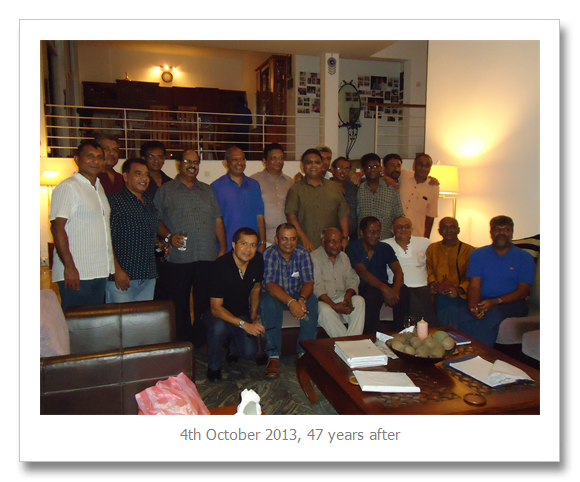
The secret of the relationship that we inherit to this day in this Class of 66, is this cohesive and togetherness that we inculcated while studying together in the same classroom on the common subjects.

The school staff in the early '60s

Class of 66
We all were enrolled in the kindergarten and obviously, we had to sit separate as we had to learn our mother tongue either in Sinhala or Tamil. The Sinhala boys were guided by Miss Merlin Fernando and Miss Erangany Karunaratne, while the Tamil boys were guided by Miss Samuel and Miss Mallar. We all wrote the first letters of our mother tongue on a stony writing slate that was encased in a wooden frame. Our tiny hands holding the stony stylus was moved on the slate in the shape of the letters by these ladies who made our brains coordinate with our tiny hands. We all had their personal touch and their body fragrance lingered around us for they were like our parents from whom we were separated at that early age.
 |
| Slate & Stylus |
There was also a sweet cedar fragrance that lingered in the classroom. This was from the water for erasing the slate. A tiny branch of cypress immersed in a container of water to sprinkle the slate for erasing gave its fragrance to the water. This was enhanced during the windy season by the breeze that came across the cypress groves. This is no more with them being cut down for expansion.
From Standard two onwards the unity started. We were all in one class for English, Art, Handicraft, Woodwork, Music, and Physical Training. We were separated only for Arithmetic and the language class.
English was taught by a way of its own in this school. The teaching and the presentations were planned and conducted by Mrs. Marshall and Mr. Charles. The Marshalls ran the Tidenham-barrow Farm in Bandarawela and they produced the famous passionfruit cordial by the brand name Passona. Mr. Charles planned the presentations on the farm and produced his teaching aids for his English classes.
Learning the English language at STPSB was a marvel. The electronic media was yet to come but Mr. Charles developed his electrics and indicator bulbs for the English alphabet. Every boy and girl was called up to a large panel depicting a ‘Vesak Pandal’ and was given a long probe with a wired attachment. At spelling, we had to touch the letter with the probe and if you selected the correct letter a green bulb would light up, and a red flash for the wrong letter. How he did this is still a mystery for me. No doubt every student liked the English class and all did very well in English.
Art and handicraft were a wonderful and fun-filled classroom with Miss Ellepola. We had long hours playing with clay and mud molding. Creating landscapes and models with titbits collected from rubbish. Every term-end had an exhibition of all the products created by the students for the parents to see. This way everyone in the class was accounted for. We created colorful designer wax candles of all shapes for Christmas from chunks of wax that were brought to class for this purpose. Everyone ended up being a creative artist of his/her own style.
There were two personalities that molded character in all of us. They were Mr. Godfrey Peiris and Mr. Markandan. Godfrey was the senior teacher for the Sinhala medium and Marky for the Tamil medium. If not for these two persons the school would not be what it is today. We were all scared of them but at the same time, we loved them. Mr. Markandan was in charge of sports while Mr. Peiris was in charge of cub scouting and the choir. Choir practices were for all despite different religious beliefs. (Religion was not to be in the school curriculum until 1964). They both took the tasks of teaching mathematics and language as well to the upper grades. They both had a common habit of calling us by their own nicknames derived from our initials or by our behavior. I was TUK reading my initials together.
Mr. Edirisinghe a very responsible person in the running of the school from Mr. Keble’s time, happened to pass away during our time. We all remember him with gratitude for having learned arithmetic from him in Standard Three. His input in STPSB is followed by Mithra and Panini his son’s and Devika the daughter who was in the Class of 66, was to continue her education at Ladies College in Colombo later.
Music was for all conducted in a common classroom by Mrs. Aileen Sarathchandra nee Aileen Beleth… wife of Dr. Ediriweera Sarathchandra, she was a renowned music and drama teacher. Every student was a member of the percussion band that was formed by her. Recorder practices were complete with public performances held at the Bandarawela Town Hall.
Special mention must be made of two ladies for running an exceptional role in the boarding in the 1960’.
They are Ms. Janze … the food matron and Ms. Ludowyke … the sister in charge of health.
Ms Janze
Ms. Janze was entrusted with the herculean task of feeding the ever-hungry boys in the five dormitories. The bigger boys were located away in the Keble dormitory that had a separate meal set up but I’m sure she had a role to play there as well.
A gentle lady probably in her late 40’s then, clad in the typical burgher’s knee-length gown with a narrow waist tightened with a slim leather belt wearing bifocals was the picture I remember of her. The kitchen that had a large coal and timber fired hearth with apron-clad male cooks and the food servers headed by the towering Chandra was commanded over by her. The longish store in the kitchen that held all the rations was her office. If I remember right the largest stock of bread that I’ve ever seen in one location was in this store. Beef, Rice, and Bread was the staple diet, and lunch would always be rice and curry while dinner was primarily bread with a beef stew made like goulash with ample carrots cabbage, and radish in it. I can bet that being a Thomian who went through Bandarawela, Gurutalawa, and Mt Lavinia……..the best ever palatable food served in a boarding school was definitely in Bandarawela. I still reminisce how we relished the minced beef cooked to a thick broth to be had with bread was never served anywhere else.
 |
| Sinhagiri Hotel |
Her quarters were a fairly large and cozy room located close to the kitchen area and the jangle of the bunch of keys tucked into the thin belt she wore would indicate her arrival close by. I’m sure she was the first to get up every day to check on the best ever school breakfast served. We had hot oat porridge cooked in ample milk. A soft-boiled egg on an enamel side plate complete with five slices of bread… one had a spread of smooth Globe Butter on it. The main plate held a spoon of ‘Pol Sambol’ [shredded coconut mixed with a touch of red peppers and a drop of lime all mixed to a dry chutney] or jam to be had with the bread. I bet many of us elders now still have the palate to mix the Pol Sambol into a soft boiled egg to be had with bread learnt 50 years ago.
Bread was supplied from the Sinhagiri bakery in Bandarawela and is considered the best for bread in Bandarawela even today. It is strange to me to this day why they did not serve us with the end crusts of the bread loaf, which is generally the tastiest portion in a loaf. The end crusts always went into a cardboard box to be roasted in the oven for crumbs. At that age, we were an ever-hungry lot after a meal until the next. And many of us frequented the kitchen area in the evenings and Ms. Janze was very generous in letting us fill our tiny trouser pockets with the end crusts to be enjoyed with friends. It would have been a vivid site to see boys rushing out of the kitchen store with bulging pockets that looked like the over-packed cheeks of the Torque Monkey that stores food that come in surplus.
Lunch was rounded off with a banana or a slice of papaw and the dinner always had a blancmange or a mousse as dessert. After the boys have had dinner the day ends for Ms. Janze as well. While we retire to our dormitories we also see Ms. Janze amble away in the kitchen corridor to her quarters hugging her reddish-brown rubber hot water bottle that would keep her warm and cozy until dawn.
STPSB being an Anglican institution; it was Ms. Janze, a very pious catholic that took the catholic boys for Sunday service at the St Anthony’s Church in Bandarawela. Unfortunately, she left STPSB early - before we would complete Standard Five, making room for her successor Mrs. Unambuwe.
Ms Ludowyke
If Ms. Janze was entrusted with keeping our tummies happy ….Ms. Ludowyke was keeping our body and mind happy. Possibly a staff nurse in the Health Services then ….showed professionality on every aspect in that field. Clad in a spotless white gown and starched triangular nurse’s cap complete in a pair of black court shoes she went about business………. and all doors in the school opened for her; be it a classroom, dormitory, dining hall, kitchen, or loo house. She was more like a present-day Health and Safety Official. Yes in fact that was what she was at STPSB. I’m sure none of us had seen her in any other attire other than this.
The day starts for her with checking the cleanliness of the drains in and around the kitchen and dining area. Her headquarters was the sick room. A cupboard here held the drugs and other nutritional intakes; Virol and Ferradol that tasted like raw steel, cod liver oil capsules, and Vitamin C that our parents brought to be given under prescribed dosages were stored in it. Cough and Cold symptoms were quite common in this climate; a brackish mixture or a decoction was prepared by her that we gulped down with a bitter salty feeling. She would be circling around the tables during meal times checking that every bit of green matter in the plate was gulped down and nothing went under the table.
Our dormitories had an elderly female domestic aid known as an “Ayah.” They were the ones that helped us dress up to school in the mornings and scrubbed us during bath time. I remember the four of them by the names Nanda, Gunawathie, Adeline & Menike. The ayahs were Ms. Luduwyke’s lieutenants; they would report of any boy showing signs of illness or even those who had unusual bowel habits by keeping note of our visits to the loo house. Prompt attention was to come from her with a visit to the sick room. A general rise in our body temperature was checked and kept under observation in the sick room until everything was normal to be discharged back into the herd.
This was the 1960’s and the Public Health Services in the country was in its early stages. The only vaccine we had had before coming to school was for smallpox. Every one of this era displayed two scars on the outside of the upper left arm showing his/her safety from smallpox. It was only around 1963 if I remember right that the government health services provided the BCG Vaccine and the Triple Injections to the masses. One day during school time, we were all herded classroom by classroom to the sick room. I remember we were trembling in fear seeing the PHI officers dressed like the police in khaki suits with hypodermic needles and syringes in their hands injecting serum to the boys who were held firm onto a chair by the servants and the Ayahs. This was all happening under the watchful eyes of Ms. Ludowyke who marked up a record card for each boy…date, age etc. By evening everyone was with a high temperature and a swelled and immobilized upper arm. The ayahs were busy with pails of hot water, fomenting our arms morning and evening for almost two days till we were normal. Disposable syringes were still to be invented then, the needles were reused after sterilizing in boiling water and they were blunt as hammerheads. It was the wounds created by these blunt needles that gave us pain more than the serum activating inside the body.
Information of any boy who had not visited the loo house for over two days was sneaked out by the ayah to Ms. Luduwyke, and he would be the recipient of a soapy enema from her with a report of its success by the ayah. All this said we kids really feared being sick… more than fearing Ms. Luduwyke. This would have been any child’s feeling at that age being away from your parents. It is only now that we realize the good lady’s commitment towards our health and wellbeing. The school had entrusted her with the enormous task of caring for our health.
I remember an incident when I injured myself while trying to leap under a barbed wire fence to visit the boutique in the hill for “Wandu Cake” with Hemasiri Kotagama [now a Prof in Statistics – University of Oman] and a spiky barb happened to split the side of my belly towards the back…….a scar that I still carry to this day. This was kept a secret for the fear of being punished until the wound festered and I picked a very high temperature. The ayah having noticed of my inactiveness… I was in the sick room on the brink of contracting tetanus and was in pain the whole night with a very high fever to be taken to the doctor in the morning. However, I had somewhat recovered in the morning to find a picture of Mother Mary wrapped in a pink rosary placed under my pillow. This was a strange occurrence to me then ………but today I realize that Ms. Luduwyke had been praying for me besides my bed in the sick room and had placed the rosary and the picture for my safety. Such was the dedication and commitment of her towards us.
 The following day I was taken to Dr. Anghie and sent home for recovery. Dr. Anghie was a very famous medical professional in Bandarawela and Badulla then. A very active sportsman and a keen ruggerite who lead the Uva Province team was the school doctor. He visited the school every Saturday to check on the sick boys and would hang on in school until the singsong sessions that he joined in with the teachers and boys. His service I’m sure was complimentary then and he was a loving character in school.
There was another personality that visited the school every Sunday. Father Geerasinghe would drive his Renault Gordini Saloon all the way up the hill to the chapel foyer for prayer service.
Mr. Jinadasa the Woodwork teacher & dancing tutor.
Mr. Jinadasa a humble man from Ratnapura was the preferred selection of Mr. W.T Keble as a woodwork teacher and instructor. The only personality in school wearing the Ariya Sinhala attire was from the performing art clan of Sabaragamuwa. Noting this specialty of his, Mr. Keble or Mr. Paul Raj would have thought of getting his services to commence a Kandian Dancing Troupe in school, outside the school curriculum.
The Dissanayake brothers Anura and Srinath, their uncle of the same age Sarath Weerasekara, Eshan Jayawickrama, and I were the official Kandian Dancing Troupe of the school. I do not remember any senior boys in particular in the troupe then…..prompting that we would have been the first set in this performing art class.
Mr. Jinadasa had a room for him in the classroom block in the Tamil medium wing adjoining the woodwork room. All the paraphernalia and costumes needed for Kandian dancing …the drums, the ‘panthetu’ [brass tambourines] the thalam pota, and the bead breast wear were all his own which he gave to us without prejudice. His room became the arena for us while real practice performances were held behind the chapel.
I’m quite sure that there was no curriculum in any of the schools in the Uva Province teaching fine art then, as it was our troupe that was taken around for any occasion in relation to the Education Office in Bandarawela. I very well remember being presented with tokens on such performances. A clean blue one rupee note placed in an envelope was given to each of us. This was to be extra pocket money for us. Mr. Jinadasa did his best for dancing and woodwork in school.
STPSB was famous for Drama and the school conducted an inter-house drama festival every year in all three language mediums at the Bandarawela town hall. The school did not have a hall of its own then. Kandian dancing was a forte at this event. I do remember a very funny incident during SLAR‘s period when we dancers performed on stage welcoming the chief guest and his wife. We were supposed to stand on marked positions on the stage and the curtain would close concealing us behind bringing the act to an end. I by mistake stood on a marked position for the first drama that was marked outside the curtain line and was separated from the rest. It took a while for me to find the overlaps in the curtain creating good-natured amusement among the audience.

The school staff in the later '60s
There were others who are also remembered with reverence. Ms. Wijewardane, Ms. Ira Collinthomie, Ms. Gamlathge, Ms. Senani Seneviratne, Ms. Perera, Mr. Fred Abeysekara, Mr. Selvadorai, and Mr. Koilpillai who later ordained robes. Most of them are no more…. and we love them all for they loved us too and brought us up to what we are today.
The office staff was different as we did not have direct contact with them in class. It was only the bursar Mr. Gnanaiah who was living outside the school. The others, Mr. P B Ratnayake and Mr. F R Joseph were active in the playing field and were our bedtime storytellers. It was FRJ who gave us shivers in the dark nights with his imaginary ghost stories……….In the end, it was he who took us home during the school vacations in a full compartment reserved in the Udarata Menike train all the way to Colombo entrusting us to our parents on the way and in Colombo. This was definitely a special school then in the 1960s.
I recall Suresh Markandan and Dileepa Lawrence Hewa communicating with me on a posting I did once of the school on my FB page. Dileepa asked me “I think I remember you at school in Bandarawela…..was it your father who cried when leaving you at school?”……this took me back to a nostalgic past ……..and I replied “yes…..he may have cried leaving me at the boarding as I remember I too cried and so did all others when their parents left them”
I’m sure every parent did cry within their hearts every time they left us at this boarding school. But they were all equally gratified for they were sure that we were in the best of care in the safest hands at St Thomas’ Preparatory School in Bandarawela.
Photographs Courtesy Ms. Erangany Selavadorai nee Karunaratne
Photographs Courtesy Ms. Erangany Selavadorai nee Karunaratne