Showing posts with label Magpie Robin. Show all posts

Wednesday, June 21, 2017

Conventional Birdwatching & the Science in Birdwatching

The conventional birdwatching is related to a science of identifying unknown birds in the field. Most books on the techniques of bird watching to beginners did convey this scientific approach to identify birds in the field. However with the advancement of the digital camera the theme for identifying new or unknown birds in the field is no longer in practice. Today a digital photograph is compared with an image in the internet or with an illustration in a field guide and the bird is described.

The system of scientific identification however is still practiced in the study of Ornithology and could be described as a methodology for identifying a bird species in the wild through a systematically developed comparison and elimination approach on six criteria. It could be further classified as fitting the observed bird into six predefined modules developed for the country. They are classified as Silhouette…Field markings…Posture…Size…Flight pattern the Habitatin which it is seen with the date and time included.

Silhouette

The silhouette in general is the back lit image of a bird viewed in black or very dark grey. This lets you to identify a general group of birds as hawks, owls, parrots, flycatchers, shrikes, storks, etc. whose members all share a similarity. Birds in the same general group often have the same body shape and proportions, although they may vary in size. Therefore the silhouette alone gives many clues to a bird's identity, allowing you to assign a bird to the correct group or even the exact species.


clip_image002


various_birds_silhouettes_vector_set_546205


Field markings and characters

In order to describe a bird, ornithologists divide its body into topographical regions; the beak or bill, head, back, wings, tail, and legs. These regions are further divided as in the diagram giving with commonly used descriptive terms.

Birds display a huge variety of patterns and colors, which they have evolved in order to recognize other members of their own species. Birdwatchers also use these features that are known as field markings to help distinguish different bird species.


An Illustrated Guide to the Birds of Sri Lanka 26-38n-5
BRD_IDFieldMks_BodyRegions_1_1


BRD_IDFieldMks_Wing


BRD_IDFieldMks_Head


Beak and Legs


The shape and size of a beak indicates the nature of its food and manner of feeding. Different beak structures have enabled birds to exploit different habitats and fit into a wide range of niches. Distinct beak shapes help identify some bird species, and some shapes help identify some common groups.

The legs though not very visible without a visual aid also relate to posture and habitat. This also could be grouped as branch grasping feet, predatory feet, swimming feet or wading feet. The length, colour and structure of the legs can assist in identification and is a very useful feature in identifying wetland birds.


An Illustrated Guide to the Birds of Sri Lanka 26-38n-6

Posture


Posture or the stance of the bird when on the perch or on ground gives a clue to help place the bird in its correct group. Members of the thrush family would stride across the yard, take several steps then adopt to an alert upright stance with its breast held forward. All thrushes have similar postures, as do larks and shorebirds. This way one could short list the bird to a possible group from the other groupings.

Distant perched crows and hawks may look alike, but paying attention to their different postures will help one to differentiate one from the other


BRD_IDPosture_Robin copy copyID_Posture_hz_1ID_Posture_v_1


BRD_IDPosture_hawkcrow copy copy


Size


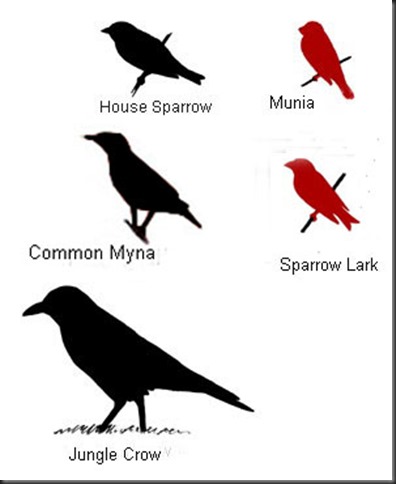
By now the bird is assigned a group based on the silhouette, some field markings and its postural stance. The next step is to do a size comparison of the bird. However the sizing could be complicated at times with poor lighting or the distance to the bird. Size comparisons are most useful when an unknown bird is seen side-by-side with a familiar species. In the case of an isolated bird the sizes is compared with a commonly known bird species such as the House Sparrow, Common Myna, the Jungle Crow, as references.


BRD_IDSizeRef_Woodpeckers copy copy copy copy

Equal in Sizes:

A crow-sized pigeon would be a Green Imperial Pigeon and a woodpecker of the size of a sparrow might be a Brown-capped Woodpecker.
BRD_IDSizeRef_ConfuseColor copy copy


BRD_IDSizeRef_InBetween_1 copy copy copy copy

In-between Sizes:

Sometimes you need two reference birds for comparison. An Ashy crowned Sparrow Lark bigger than a sparrow but smaller than the Myna. A cuckoo is larger than a Myna but smaller than a crow.

Flight Pattern


Most birds fly in straight lines flapping in a constant rhythm, but certain bird groups have characteristic flight patterns that can help identify them. Birds of prey may be identified by the characteristic way they hold their wings when flying toward you. A flying accipiter such as the Shikra or Goshawks would typically make several wing flaps followed by a glide. The eagles and kites soar up in circular motion with the thermal currents and are generally not seen flying until mid-day. Barbets and Woodpeckers generally fly in a pattern of moderate rises and falls. The woodpecker flap wings at the fall while the barbet flaps wings at the rise.

Habitat


In general, each bird species occurs only within certain types of habitat. It could be a dense forest as the Sinharaja, the scrub jungles in the low country dry zone, montane cloud forests in the central massif, and the rolling lands of the lower Uva Patna or freshwater marsh. For instance a given habitat will contain its own predictable assortment of birds and with time one can learn which bird to expect in a particular habitat.

It should also be noted that it is always possible to encounter an unfamiliar bird in a location considered outside its usual habitat. Migrating birds in flight often settle down when they are tired and hungry regardless of the habitat.

This is the general scientific methodology derived to identify a bird species in the field. However the notes taken in the field should be compared with a good descriptive bird guide to confirm the sightings. Viewing distant birds would be assisted by viewing aids; a suitable pair of binoculars or spotting scope. Nevertheless the general grouping of birds could be achieved even without viewing aids.

The other very important rule in the field is that the welfare of the bird comes first and not that of the birdwatcher. World birdwatching bodies have developed birdwatching ethics that are universally accepted and birders need to be self-disciplined in this aspect.

The general factsheet on ethical birdwatching is as below:

Promote the welfare of birds and their environment

• Support the protection of birds and their habitat
• Avoid stressing birds or exposing them to danger
• Avoid using methods such as flushing, spotlighting and call playback, particularly during nesting season when birds may be called off incubation duties, or even abandon the nest altogether
• Be aware of the impact photography can have on birds - avoid lingering around nests or core territories for long periods and limit the use of artificial light
• Avoid handling birds
• Report rare bird sightings to conservation authorities and consider the wellbeing of the bird before making this knowledge more publicly available
• Stay on roads, trails, and paths where they exist- avoid leaving litter along a birding trail and otherwise keep habitat disturbance to a minimum

Respect the law and the rights of others

• Do not enter private property without the owner’s explicit permission
• Follow all laws, rules, and regulations governing use of roads and public areas
• Consider and respect the rights of landholders
• Practice common courtesy in interactions with other people

Group Birding Ethics

• Lead by example and know your audience – encourage others to employ ethical birding practices
• Report bird sightings – all data are useful to bird conservation and wherever possible, should be reported to ornithological databases in the country example Universities, Natural History Museums, etc. [in Sri Lanka, FOGSL ]
• Impart knowledge – share what you know about birds and their habitats
• Get involved – encourage birders to engage local communities and get involved in conservation initiatives at their favourite birding locations
• Consider the birds – always put the health and well being of birds first- consider the impact you as an individual and the group are having on birds and their environment

Sunday, July 13, 2014

Spring is over; it’s Summertime

It’s a Saturday morning in the month of July and I'm still in bed at home in Galle; a township deep down in the south of Sri Lanka…listening to the morning melody of the birds in the garden calling me out of bed… they all seem to say; ‘gone are the rains and sunny days are back.’ 

This year the monsoon rains were very much on time unlike last year. 

Yes I know it’s going to be a bright and sunny day as it’s been a long time since my bedroom wall caught the morning rays that stream through the windowpane. I’m still lazy though when I hear a unfamiliar call….not heard before in our garden and I’m sprung out of bed into the garden looking for my new feathered friend. My guess was right it was the Black-headed Cuckoo Shrike calling high up in the mango tree [Mangifera Indica]… it was a male bird whistling a high pitched, wheep-wheep-wheep while hopping about in the brightly lit canopy
.
BhCS
Black-headed Cuckoo Shrike

Ehela
A riot of yellow - Ehela in bloom
Happy and content with the new found friend I wonder about in the garden. It’s high activity all around. The parched and dry weather in March-April, that wilted my three Ehela trees [Cassia fistula] forcing them to drop every leaf and bloom out into a riot of yellow is now a deep green. The monsoon rains that followed have triggered off new life into them and are now adorned in new foliage. The Black–hooded Orioles are busy in them staining their black hoods in odd angles looking for grub. The Ehela trees are ready again to host the larvae of the Lemon Emigrant, and the Common Grass Yellow, the two butterflies that prefer the Ehela to lay their eggs. Very soon the fresh foliage will be chewed up by the larvae and the Orioles and the Bul-buls with the Magpie Robins and the Tailor Birds will be feasting on the fattened larvae before they go into pupa. 


Foliage
A deep green
Oriole 1
Black-hooded Oriole
Oriole 2


There is more activity in the shades among the Anthurium’s I see. Approaching them stealthily I'm almost in touching distance with three fledglings hopping about in the sand calling out to the parents who keep feeding them constantly. My wife Hemamala joins me and inquires as to what they are. “They are Magpie Robin chicks” I say to her disbelief. Yes the chicks have mottled beast feathers that fade away in adulthood. The Magpie Robins have had a successful brood this season with three chicks surviving; thanks we do not have a feline pet with us now.”


MR 4
Exploring the surround
MR 2
Magpie Robin chicks with mottled breasts
Earlier on inside the weep-holes in the stone wall opposite our bathroom fanlight, nested the White-breasted Kingfishers. They too were successful this year as the rat snake that inspects these cavities for cleanliness was a late comer this year. I now see four Kingfishers flying about in the garden. 

DSC_1018
The bathroom fanlight a hideout for photography
This is the cycle of nature that keeps going year round in this little green patch that we maintain around the house in Galle; a 14 perch housing block. What a friendly atmosphere and I get the feeling that all these feathered friends take time off to thank us every summer for helping them keep their progeny alive year round.

WP1
Black- rumped Flameback
Just as I was about to go into the house, I hear him thanking me in his own special way. Yes the Black-rumped Flameback is on the mango now and is drumming away for me, trur…rrrrrrrrrrrrrr 

WP 2
Drumming away happily
Very soon in two months’ time there would be other friends coming over. The Brown Flycatcher, Brown Shrike and the Indian Paradise Flycatcher are regular migrant visitors to our garden. They have an annual reservation in the Mango the Biling [Arerrhoa bilimbi] and the Kathuru-murunga trees. [Sesbenia grandiflora] 

DSC_0002
Indian Paradise Fly-catcher

But this year I'm reluctant to provide all of them with a regular service that I continued all year-round before. Our birdbath will only be filled again once the local authorities have completed their inspections on mosquito breeding sites; a precautionary procedure to arrest the spread of dengue.

Wednesday, March 5, 2014

Back to School after 48 Years

It’s a long time since I hung my boots from government service and now serving  a private sector consultancy in Architecture and Engineering. A young colleague working with me on two hospital projects in Hambantota and Nuwara Eliya  is Architect Danajaya Bandara [Dana]; a product of S Thomas’ College Bandarawela and is 20 years my junior. We are of two different eras in the same school. I being form St Thomas’ Preparatory School and him from S Thomas’ College Bandarawela.
The school is now upgraded to a senior school while it was only a junior school then.   
.   
We had been to Hambantota for a meeting and were travelling to Nuwara Eliya when we decided to stay overnight in Bandarawela.  It was obvious and apparent that we both would visit school before getting to Nuwara Eliya on 27th Feb 2014.

We belonged to two different eras at school, the Keble era and the SLA era. However I was more on a transition period. Mr Keble had left in 1956, entrusting duties to Mr Paul Raj . Mr S L A Ratnayake [SLA] succeeded Mr Paul Raj in 1964. SLA developed the infrastructure to its present state from where Mr Keble  left in 1956.

I had left school in 1966...........  but today I enter through an archway that have replaced the large white masonry pillars on which hung two large black swing gates made of steel and timber that were strong and sturdy. It is with  sanctity and high nostalgia that I step in this land which molded me to what I am today. Thanks to those dedicated mentors who cared of us......they need to be  remembered with much gratitude.

There are significant landmarks that have survived the test of time after 48 year.  I keep clicking my camera until it said the card is full…… 

DSCF9515

This is Wijewardane dormitory. it was a single storey building then. The old music room is still at one end of the dorm. It was in this room that we sang along with Ms Blanchard, Ms Marshall and later with Ms Sarathchandra the former wife  of late Prof Ediriweera Sarathchandra.

On the other end is the Corea dormitory which is the same old single storey building. The flowerbeds on the opposite side of the road are no more, probably to accommodate two-way traffic. It was only the Headmaster’s car and Rev:Father Jeerasinge’s Skoda that plied this road then.

DSCF9560
The Corea dormitory  looks the same even after 48 years. The rainwater harvesting  tank at the corner of the dorm is still serving as a collection pond. I could remember this tank as a tiny tot. It was as high as my chin then, which is not more than 2’ 6’’ tall.
.
DSCF9517
It was this water that served as our bum wash, when the water ran dry in the faucets. The  old loo house in Corea,  still has those ledged braced and battened doors. The typical timber door detail that we drew on our drawing boards back in the first year at university for engineering drawing practice in building construction.


DSCF9519

The embankment behind the kindergarten building alongside the small play area that held the two swings and the see-saw still looks the same. The play  area now holds a building. The tiny driveways that we carved into this embankment forming a mini Khyber Pass where we played with our Dinky Toys on Sundays have all but got washed with time. Present day boys hardy play with Dinky toys anymore. Times have changed.

DSCF9520
The open Arena during the Keble era is replaced with a kindergarten play area.

DSCF9561

The pathway down to the spout where we went for our weekly bath is now cemented. Boys do not bathe in the spout anymore and the waterway is not rich as then. The large buttercup trees that lined this path have gone. We collected the tiny buttercups that dropped after flowering on our way to the spout.


 DSCF9521

The dinning hall is the same old building but the partition that separated Ms Unambowe’s tuck shop is now incorporated in the dinning area. The blue Formica laminated long tables are still existent. The brown benches are now blue. I recall the mealtimes where Ms Janze  and Ms Luduvyke supervised us. Everything on the plate was deemed edible. There were times when murunga and mellum was found under the table and all in that table were punished. We were not of the habit of taking goodies from others’ plates  but loading them with the unpalatable stealthily.

DSCF9565
DSCF9564

The old trophies from Mr Keble's hunting trips that decorated the dining hall walls are no more.The old school photos that lined the top rail on the walls from 1948 onwards are still there. The indelible ink writing on the 1948 photos have stood the test of time.  The floor has the touch of the new trend; ceramic tiles.


DSCF9522
DSCF9557 

The ground in front of the Blanchard dorm is still spacious where the scouts of  Gurutalawa  had their campfires when they camped here with Rev: Father Goodchild. This dorm too has grown taller and it is sad to see A/C comfort needed in Bandarawela now. The dhoby days are gone; get the feeling that the soiled linen is washed within in machines and dried on the fence.


  DSCF9525

It is with great reverence that I stood here still; my head held high looking on at the old school crest on the gable forming the portico where the Headmaster parked his car. Also it is rewarding to see this piece of legend not replaced when the School became a Collage and changed its motto from ‘THE LORD IS MY SHEPHERD’ to ‘ESTO PERPETUA’. However it is sad to see this view distorted by the roofed stair way.  I feel it is unnecessary here. It was SLA who roofed the pathways from the dorms to the dining hall.

DSCF9529

DSCF9537

The red trapezoidal walls holding the canopy over the entrance to the corridor of the main building near the old school office is still intact. Not much change in the classrooms of yesteryear. The old Tamil medium section is still seen in the rear of the main building probably used  for other purposes now. The lodging house of the  office aid cum school supplier who rode daily to Bandarawela on the Humber delivery bicycle whose name I forget is  now a workshop.

 
DSCF9539

The most pristine piece of architecture of the old school was the little chapel that came up during Mr Paul Raj’s period. The construction of it was a great experience to us. The building premises were out of bounds to us but we stared at the busy workmen going about their daily scores from an allowed distance. The chapel was later added with a belfry outside in the garden. We non-Christians were very much the choristers then
.
We had morning prep in the class rooms and were allowed outside of class to recite Sinhala Kavi and English Poetry loudly in order to memorize and recite byheart when in the class. This loud recitation was allowed  behind the chapel as its granite walls would buffer our loudness to those studying in the classrooms.

The need to be outside of the prep class was not mainly to byheart kavi but to catch the morning sun to rid the severe cold that prevailed towards the year end. We used to sit at the chapel doors or in the drain edges catching the morning sun but occasionally being punished for chatting while sunning.


DSCF9555
Dana with me at the Chapel

DSCF9541
DSCF9540


The doorsteps and drain gullies where we sat sunning

Panorama6


A new upper school building complex has come up alongside the chapel to match with the architecture. 


DSCF9559

It was very sad to see the play ground that had a green carpet of grass bare of it now. The old pavilion building looks ancient and dilapidated. The roof has had a new cladding but for the building.   

DSCF9563

The games viewing benches done in 1965 by SLA was a novel idea making use of the embankment. The benching has now been extended. This may have had a negative effect in upgrading the old pavilion.

DSCF9514

Finally the landmark building of the school, the Keble Memorial Hall designed by yet another old boy  late Architect Lala Adithiya stands solid at the entrance to the school. The work on the land leveling for the building commenced in my last year in school, 1966. SLA was very instrumental in  organizing many fund raising activities to raise the cost of construction. We boys carried brick cards home with each brick named after the wardens and dignitaries associated with S Thomas’ Colleges and Schools. If I remember right a full card collected 100 rupees. This was quite a sum then. The monthly school bill would also be around Rs 120 then. Madduma Ratnayake's family contributed with machinery for the land levelling while M Y Hemachandra & Co was the building contractor, another parent.

DSCF9566   The Keble Memorial Hall

We met three present day teachers Mr Denzil, Mr Bandara and Mr Lal who were very generous in serving us tea. They were impressed of my narration of how the school was then and of the letter writing that was mandatory on Sunday. Today it is the mobile phone that contact parents. Times have changed.

We discuss about school running now. One significant change seen today is the number of day scholars have exceeded the boarders. Get the feeling that priorities have changed from a boarding school to a day-school. This is reflected from the playground being bare of grass. It was here that we spent much of the evenings with Mr Markandan the Games Prefect. The grounds do not seem a priority anymore.

We discuss about any assistance that we could provide on engineering and architectural expertise. The need for developing the pavilion was a requirement, both Dana and I would like to look at it seriously.

It was a memorable visit for me and this writeup is for all of us who passed-out from this institution, and are indebted for all that we received.