Showing posts with label Jungle Crow. Show all posts

Wednesday, June 21, 2017

Conventional Birdwatching & the Science in Birdwatching

The conventional birdwatching is related to a science of identifying unknown birds in the field. Most books on the techniques of bird watching to beginners did convey this scientific approach to identify birds in the field. However with the advancement of the digital camera the theme for identifying new or unknown birds in the field is no longer in practice. Today a digital photograph is compared with an image in the internet or with an illustration in a field guide and the bird is described.

The system of scientific identification however is still practiced in the study of Ornithology and could be described as a methodology for identifying a bird species in the wild through a systematically developed comparison and elimination approach on six criteria. It could be further classified as fitting the observed bird into six predefined modules developed for the country. They are classified as Silhouette…Field markings…Posture…Size…Flight pattern the Habitatin which it is seen with the date and time included.

Silhouette

The silhouette in general is the back lit image of a bird viewed in black or very dark grey. This lets you to identify a general group of birds as hawks, owls, parrots, flycatchers, shrikes, storks, etc. whose members all share a similarity. Birds in the same general group often have the same body shape and proportions, although they may vary in size. Therefore the silhouette alone gives many clues to a bird's identity, allowing you to assign a bird to the correct group or even the exact species.


clip_image002


various_birds_silhouettes_vector_set_546205


Field markings and characters

In order to describe a bird, ornithologists divide its body into topographical regions; the beak or bill, head, back, wings, tail, and legs. These regions are further divided as in the diagram giving with commonly used descriptive terms.

Birds display a huge variety of patterns and colors, which they have evolved in order to recognize other members of their own species. Birdwatchers also use these features that are known as field markings to help distinguish different bird species.


An Illustrated Guide to the Birds of Sri Lanka 26-38n-5
BRD_IDFieldMks_BodyRegions_1_1


BRD_IDFieldMks_Wing


BRD_IDFieldMks_Head


Beak and Legs


The shape and size of a beak indicates the nature of its food and manner of feeding. Different beak structures have enabled birds to exploit different habitats and fit into a wide range of niches. Distinct beak shapes help identify some bird species, and some shapes help identify some common groups.

The legs though not very visible without a visual aid also relate to posture and habitat. This also could be grouped as branch grasping feet, predatory feet, swimming feet or wading feet. The length, colour and structure of the legs can assist in identification and is a very useful feature in identifying wetland birds.


An Illustrated Guide to the Birds of Sri Lanka 26-38n-6

Posture


Posture or the stance of the bird when on the perch or on ground gives a clue to help place the bird in its correct group. Members of the thrush family would stride across the yard, take several steps then adopt to an alert upright stance with its breast held forward. All thrushes have similar postures, as do larks and shorebirds. This way one could short list the bird to a possible group from the other groupings.

Distant perched crows and hawks may look alike, but paying attention to their different postures will help one to differentiate one from the other


BRD_IDPosture_Robin copy copyID_Posture_hz_1ID_Posture_v_1


BRD_IDPosture_hawkcrow copy copy


Size


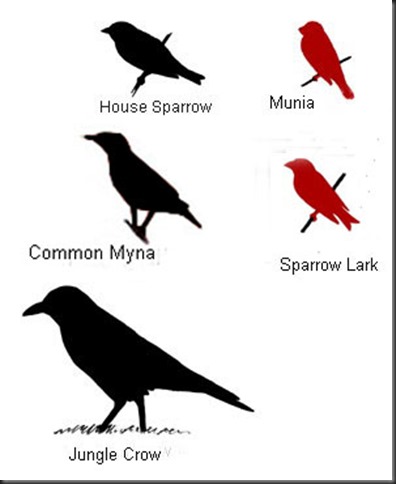
By now the bird is assigned a group based on the silhouette, some field markings and its postural stance. The next step is to do a size comparison of the bird. However the sizing could be complicated at times with poor lighting or the distance to the bird. Size comparisons are most useful when an unknown bird is seen side-by-side with a familiar species. In the case of an isolated bird the sizes is compared with a commonly known bird species such as the House Sparrow, Common Myna, the Jungle Crow, as references.


BRD_IDSizeRef_Woodpeckers copy copy copy copy

Equal in Sizes:

A crow-sized pigeon would be a Green Imperial Pigeon and a woodpecker of the size of a sparrow might be a Brown-capped Woodpecker.
BRD_IDSizeRef_ConfuseColor copy copy


BRD_IDSizeRef_InBetween_1 copy copy copy copy

In-between Sizes:

Sometimes you need two reference birds for comparison. An Ashy crowned Sparrow Lark bigger than a sparrow but smaller than the Myna. A cuckoo is larger than a Myna but smaller than a crow.

Flight Pattern


Most birds fly in straight lines flapping in a constant rhythm, but certain bird groups have characteristic flight patterns that can help identify them. Birds of prey may be identified by the characteristic way they hold their wings when flying toward you. A flying accipiter such as the Shikra or Goshawks would typically make several wing flaps followed by a glide. The eagles and kites soar up in circular motion with the thermal currents and are generally not seen flying until mid-day. Barbets and Woodpeckers generally fly in a pattern of moderate rises and falls. The woodpecker flap wings at the fall while the barbet flaps wings at the rise.

Habitat


In general, each bird species occurs only within certain types of habitat. It could be a dense forest as the Sinharaja, the scrub jungles in the low country dry zone, montane cloud forests in the central massif, and the rolling lands of the lower Uva Patna or freshwater marsh. For instance a given habitat will contain its own predictable assortment of birds and with time one can learn which bird to expect in a particular habitat.

It should also be noted that it is always possible to encounter an unfamiliar bird in a location considered outside its usual habitat. Migrating birds in flight often settle down when they are tired and hungry regardless of the habitat.

This is the general scientific methodology derived to identify a bird species in the field. However the notes taken in the field should be compared with a good descriptive bird guide to confirm the sightings. Viewing distant birds would be assisted by viewing aids; a suitable pair of binoculars or spotting scope. Nevertheless the general grouping of birds could be achieved even without viewing aids.

The other very important rule in the field is that the welfare of the bird comes first and not that of the birdwatcher. World birdwatching bodies have developed birdwatching ethics that are universally accepted and birders need to be self-disciplined in this aspect.

The general factsheet on ethical birdwatching is as below:

Promote the welfare of birds and their environment

• Support the protection of birds and their habitat
• Avoid stressing birds or exposing them to danger
• Avoid using methods such as flushing, spotlighting and call playback, particularly during nesting season when birds may be called off incubation duties, or even abandon the nest altogether
• Be aware of the impact photography can have on birds - avoid lingering around nests or core territories for long periods and limit the use of artificial light
• Avoid handling birds
• Report rare bird sightings to conservation authorities and consider the wellbeing of the bird before making this knowledge more publicly available
• Stay on roads, trails, and paths where they exist- avoid leaving litter along a birding trail and otherwise keep habitat disturbance to a minimum

Respect the law and the rights of others

• Do not enter private property without the owner’s explicit permission
• Follow all laws, rules, and regulations governing use of roads and public areas
• Consider and respect the rights of landholders
• Practice common courtesy in interactions with other people

Group Birding Ethics

• Lead by example and know your audience – encourage others to employ ethical birding practices
• Report bird sightings – all data are useful to bird conservation and wherever possible, should be reported to ornithological databases in the country example Universities, Natural History Museums, etc. [in Sri Lanka, FOGSL ]
• Impart knowledge – share what you know about birds and their habitats
• Get involved – encourage birders to engage local communities and get involved in conservation initiatives at their favourite birding locations
• Consider the birds – always put the health and well being of birds first- consider the impact you as an individual and the group are having on birds and their environment

Tuesday, April 14, 2015

A Night Under Canvas in Uda-Walawe…..for Birdwatching before Breakfast

Prabuddha my nephew who runs a small time tour operation calls me in late December 2014 inquiring if I would accept an offer on a very concessionary rate; full board basis to be under canvas for one night at  Wild Trails in Uda Walawe. His inquiry no doubt is because I wouldn't let off such an offer being ever so addicted to be out of doors.

The date is 27th December ……. my family with two other are scheduled to meet at Wild Trails by evening.

sri-lanka-mapUda Walawe in Sri Lanka is located midland more southwards from the central massif. The township being the nucleus of the Uda Walawe Multipurpose Irrigation and Land Development scheme in the 60’s. Its iconic component is the Uda Walawe reservoir; and its eastern flank and the catchment-area is declared a National Park. The park being of rolling savannah land devoid of large trees and jungle is home for a large elephant population. It is said that when the land was cleared for development the large fauna was trans-located in the park. Its flagship species under conservation is the Asian Elephant.

Though popular among the visitor for the pachyderms, it is no doubt a haven for the birdwatcher….and that is the only reason why I am here.


Walawe

We are all at Wild Trails by 7:00 p.m. having  been to places of interest around here and are shown our abodes for the night …..dinner is from 8:00 p.m. to 10:00 p,m.

DSC_0482

These large canvas abodes are very much taller than the conventional ones where one is more in a crouched position until you retire for the night. These large ones had three compartments separated by zipping up celluloid flap ways. The front being a veranda with chairs to sit and gaze the outside while the center being the bed room with basic facilities that are to found in a hotel room but located differently around the three beds. The back compartment being the loo and the shower positioned on pebbles and paved stones: the shower was open to the sky. If not for the comfort of condition air in the room from a split unit A/C all the rest was on a natural setting with the  canvas adobes located alongside the River Walawe.

The timing being just after days of torrential rains in the country the reservoir was brimming and the sluices opened out releasing excess water to the river. This part of the river would otherwise be dry being very close to the earthen barrage built across the river to form the reservoir. We had the natural river flowing this day and a unique feeling for everyone for sure.
SAM_1078

After a three course dinner had under candle light, the itinerary for the following day was discussed. Excepting for the three of us all the rest preferred to sleep in to the morning hours. Their preference was to sticking to the premises till noon. This is not why I am here; we request a jeep at six in the morning for a birding safari in the park…

The night was cool with the drizzle that continued deep into the night. The wet weather did away with the need for the A/C to keep on humming in to the night….. The melody of the rippling river outside the tent lulled us into deep slumber. Our weary limbs lay in comfort on clean bed linen under heavy canvas.

Yes… a different form of pampered luxury altogether.

DSC_0485


We are up by 5:00 a.m. and I'm clad in earth colors for  birding. The overnight drizzle has taken away the thick dust clouds that would otherwise cover convoy of jeeps on these dirt tracks in the park. 


IMG_00000217
SAM_1093


We  follow a different path from all the other jeeps that are to run behind each other looking for the elephants.

With the spring round the corner the peacocks were ready in their colorful long train feathers displaying in the morning light…..a qualification for the prospective maids.

DSC_0549


DSC_0543


DSC_0566

The vast open expanse of Uda Walawe is ideal for viewing raptors round the year.
DSC_0510
DSC_0503


The Changeable Hawk Eagle and the Black-shouldered Kite are common residents over here.

The Common Kestrel a regular winter visitor was seen with a birdie prey in the distance.

DSC_0622
DSC_0623CSC_0626

DSC_0524


DSC_0525


DSC_0526


This Barn Swallow preening in a prickly surround was a pleasing site  to watch. Away from the other jeeps the birdlife was all for us to keep.


DSC_0567

The Orange-breasted Green Pigeon was no doubt the capture of the trip …it was just two meters away from the jeep and would not leave, for we were that quiet.

 DSC_0598

The pop……pop…….pop…..of the Coppersmith Barbet was heard in this fig tree. My random clicking on auto focus produced this unusual capture almost camouflaging it…. if not for the bright coloration of its head.


DSC_0529


A Grey-breasted Priniya is very vociferous in saying……… I’m over here for you  to look at.

DSC_0533


This juvenile Rufous-winged Bushlark was lazy on the ground. When active it would call loud and jump high into the sky to parachute into the grasses to attract the fairer sex.


DSC_0576
DSC_0575 crop

A Little Green Bee-eater is a sight to watch. Leaving its perch to grab the insects in flight only to return to the same perch.
If you lost the focus to click it the fist time it is guaranteed  to return for you for the second click.


DSC_0580


This Red-wattled Lapwing was contrasted against a lake thick of green algae.


Sirkeer

My longing to see the the Sirkeer Malkoha became a reality while at this pool. A bird of the dry parched shrub land, always on the move, a difficult one to capture. 


DSC_0642


The Rosy Starling a migrant from the Indian Peninsular during this time of the year'


DSC_0644


The Black-headed Munia


DSC_0645


The Whooly-necked Stork


DSC_0605

The torrential rains had swelled the reservoir and the tilapia had made its way to the rich grassy fodder the new water spread had brought in. Once the water reseeded the tilapia were marooned  bring about a feast on the fast food for the Jungle Crows.


DSC_0603


Finally after almost three hours of birding we are closer to the gate and encounter  the elephants.

DSC_0495


The worlds largest land animal in comparison to a White-breasted Kingfisher

DSC_0591


Elephants in Udawalawe are constantly monitored under research study. This mother is under study and is wearing a radio collar.


DSC_0506
This young calf from the orphanage has just been released to the wild


A memorable three hours spent but slightly disappointing for not having seen the Malabar Pied Horn-bill or the Grey Horn-bill, a very common sight over here, we are back at Wild Trails. We walk into a breakfast table laid for us...  our colleagues have just finished their breakfast.


Bags packed we leave the others behind on our second leg of the vacation to Arugam Bay in the East Coast of Sri Lanka.


Monday, July 30, 2012

That Crow on Horton Plains will stay there much longer……….

Ever since the Horton Plains was declared a National Park in 1988; so was the influx of  busloads of visitors to view the famous escarpment named the World’s  End. Its a pity that most visitors only come here to view the precipices and the Baker’s Fall. They seem to be ignorant of the fauna and flora that is unique to the plains and its pre-history.

Panorama 10
People come here  in buses, vans, cars

Be that as may ……..with the human visitor there came on the plains the Jungle Crow that is known to  keep company with humans. The crow is also known as an indicator species on the changing environment. A close ally with trash and garbage . 

DSC_0329 WE copy
Little World's End Escarpment

Food and water was permitted on the 9 km trek to the World’s End and back for the weary traveller who was hungry and thirsty. Part of this  food was left on the plains as waste on which the crows feasted.
Today the authorities are more concerned and they do not allow food in wrappers in the park and much of the unconsumed food come back in the backpacks the visitor carries along.  Thus the crow is not directly dependent on  the waste food.

It has now adapted a new survival strategy………………..

Animals are said to make strange and odd partnerships. These strange relationships are needed for their safety and to overcome the struggle for existence. They are know as Symbiotic Relationships in the study of Field Biology. One animal helping the other to meets its needs. 

DSC_0339 (2) crop copy
A Symbiotic Relationship
DSC_0341 crop copy
Looking for the tick
The Jungle Crow that came on the plains has now made a symbiotic relationship with the Sambar Deer. It is interesting to note that the tick on the Sambar Deer that guzzles its blood is also a symbiotic relation, but the ticks do not help their host; instead they  pass germs that cause disease.

On the other hand the symbiotic relationship of the crow with the sambar deer  is a favourable one as the crow consumes the disease causing tick. 

DSC_0346 blog copyDSC_0351 (2) blog copy

 The crow on the Plains will adapt to its needs

The Jungle Crow being a omnivore would adapt to most conditions and this Jungle Crow in the plains is going to stay there for a very long time. This is because animals know best, the means of survival living together with other species of animals.