Sunday, July 7, 2013

Dambulla the Best Preserved Cave Temple in Sri Lanka

 
Dambulla a town situated in the border of the Central and North Central Provinces of Sri Lanka has been in the limelight from ancient times. Today it is a bustling commercial hub ‘The Awakened City’ attributed for its banks being kept open 24/7 for business. The transit point for all agricultural and farm produce coming from the central hills and the extreme north of Sri Lanka.


maplarge copy 


The history of Dambulla goes back to the 1st century. based on a large cave formation on a massive, gargantuan rock outcrop that is visible from miles around the plains. Earliest recorded history says King Uttiya [267-257 BC] donated the caves to the Sangha [Buddhist Clergy] as dwellings. King Walagambahu, who became the king for the second time, converted it to a Buddhist image house. King Walagambahu was deposed in the South Indian Chola invasion of 103 BC; while being just five months in reign. The Maha Kalu Sinhalaya [the dark skinned Sinhala King] fled the city of Anuradhapura into hiding for 14 years, living in caves and other, organising forces for invasion. He regains the Kingdom for a second term defeating the Chola in 83 BC and reign till 77 BC. Almost all the caves where he dwelt during the 14 years in hiding were converted to Buddhist temples or image houses. Dambulla being the largest and best preserved has had state patronage from succeeding rulers.

DSC_0988
DSC_0986 copy


Colonial history in Sri Lanka notes two insurrections against the British rule in 1817 and 1848 that are connected to Dambulla. During the Uva rebellion in 1817 the British troops that were sent to Matale to quell the out brake is said to have been quartered in the Dambulla Cave Temple, with the strictest orders issued against doing any damage to the image house.

6043328-At_The_Foot_DambullaSri-Langka-Cave-Temple-of-Dambulla


In 1848 the economic recession in the United Kingdom, burdened the Kandian peasantry with direct taxation from the colonial rulers. License fees were imposed on guns, dogs, carts and shops. Labour on plantation roads was made compulsory. The taxes bore heavily on the purse and traditions of the Kandyan peasant. A mass movement against the oppressive taxes was developing. The masses without a King and their chieftains crushed in the Uva rebellion sort leadership through ordinary people. In July 1848, Gongalegoda Banda is consecrated as "Sri Wickrama Siddapi" by the head monk of Dambulla Vihara, Ven. Giranegama Thera. His brother Dhines, was declared the sub-king, while Dingirala named the uncrowned king of the Sath Korale [Seven Counties]. Puran Appu was appointed the prime minister to Gongalegoda Banda. It is noted that an army of around 4000 left Dambulla via Matale to capture Kandy from the British. They attacked the Kachcheri Building in Matale, destroying tax records. Dingirirala instigated attacks in Kurunegala. Martial Law was declared in Kandy and Kurunegala. Puran Appu is taken prisoner and executed. Gongalegoda Banda and his brother Dhines goes into hiding. They were arrested and put on trial for waging war against the British King. The court condemns them to be hanged. Subsequently, a proclamation is issued to amend the death sentence to 100 floggings and deportation to Malacca [Malaysia]. 

It is this defiance nature of the Dambulla Temple that distanced it from the other two superior temples of the Kandian era; the Malwatte and the Asgirirya. One could conceive it to be the same rebellious approach the temple has had in recent times against the Kandalama Hotel that came up in its vicinity, the demand to build the Dambulla Cricket Stadium on temple land, the launching of a national radio broadcasting channel ‘The Rangigiri Dambulla Radio”. The new Rangirir Dambullu Temple built at the foot of the pathway to the cave temple with a colossus Buddha statue depicting the Mahayana features and lately the displeasure towards a mosque being renovated and expanded.
As importantly however, some things haven not changed. In particular the richly painted cave temple still attracts a multitude of travellers and pilgrims as in the past. Dambulla today is a world renowned tourist destination in Sri Lanka and  a node point within the cultural triangle of tourism. [the area within the cities of Anuradhapura, Pollonnaruwa and Kandy] 

DSC_0023 copyDSC_0037 copy

The uniqueness of the Dambulla Cave Temple is that it has been well preserved restored and upgraded with state patronage throughout. Records show that King Nissanka Malla [1187-1196], renamed the temple the Rangiri Dambulla after restoration and gold gilding of several Buddha images. King Keerthi Sri Rajasingha [1747-1782] restored the complex completely and converted the third cave as an image house and introduced his own statue in it. The next major phase of development took place in the 18th century; the upper terrace was restored and refurbished. The painted surfaces within the caves were re-painted or over painted in a style characteristic of the Kandian era. The front screen walls were rebuilt and roofed to form an outer veranda.  Even with the royal patronage ending in 1815 [the king of Kandy is captured and deported by the British], periodic repainting of sculptures and touching up of the deteriorating surfaces continued. In 1915, thanks to the efforts of a local donor, the 5th cave was entirely repainted. The veranda was rebuilt incorporating a mixture of European and Asian detailing, with an entrance porch reconstructed in a conjectural 18th century style in the 1930’s.

DSC_0967 copy
DSC_0969 copy
DSC_0972 copy

The paintings have been touched up by folk artists who were assigned on royal decree. Jeevan Naide from Nilagama was the last link of this Sittara clan who passed away recently. The restoration work by the Nilagama family has been recorded in detail in the Nilagama Tudapatha, [a palm leaf manuscript] where the skill of Jeevan Naide and his ancestors is dealt in detail. The pigments were from vegetable dyes and soil forms mixed with oil extracted from the bark of the Dorana tree that gave a varnished sheen to the paintings preserving it from insects. The paint brushes too were made of natural plant fibre; mainly Vatekeiya [Pandaness] and cat fur.
 
DSC_0974 copy
DSC_0976 copyDSC_0977 copy


Dambulla has also one of the richest collections of Sri Lankan sculpture amounting to 158 Buddha images in the form of standing, meditating and reclining postures. Outstanding figures of gods, deities and Bodhisatva [Future Buddha] and three royal portrait sculpture. A large number of these statues date from the mid Anuradhapura period. Even though these images have been restored their original styles and iconography have been preserved. The materials used for the sculpture were wood, bricks, clay, terracotta and even live rock and cotton netting. 

DSC_0979 copy


Dr Ananda Coomaraswamy’s treasured book ‘The Medieval Sinhala Art’ come into life at Dambulla. The joinery in timer work in the door sashes, the stone work in the door frames and the intricate timber door bolts the ‘Dandu Agula’ are all still serving good ….though centuries old. 


DSC_0971


DSC_0983 copy
DSC_0981 copy


DSC_0982 copy

 
 The ‘Dandu Agula’ still in good order… though centuries old


Sunday, June 9, 2013

Somawathiya–the Stupa that gets flooded annually?


Sri Lanka, this thrice blessed land by the Buddha, is said to have changed spiritually, culturally and politically with the arrival of Arahat Mahinda in the 2nd century BC during King Dewnapiyatissa’s reign. It is this cultural change that created the magnificent stone architecture of Samadhi and Auwkana Buddha statues of Anuradhapura and the immaculate Gal Vihara of Pollonnaruwa 

DSC_0292
The immaculate Gal Vihara in Pollonnaruwa
However one needs to be mindful that the engineering ingenuity of the Sri Lankan Hydraulic Civilisation and their knowhow of soil mechanics and soil engineering which created wondrous reservoirs and aqueducts was a unique speciality of this land long before the social transition that came with Arahath Mahinda. 

The most universal Buddhist architectural symbol the Stupa was first built in Sri Lanka in the 5th Century BC. It was the Buddha himself giving its design to Thapassu and Balluka the merchant friends who wanted to build a memorial to honour him. Buddha is said to have folded one of his robes into a square and placed his upturned begging bowl and the umbrella on top of it, thus outlining the basic shape of the dagoba or stupa. Upon the request of the merchant friends for an object for veneration, Buddha offered them the Sacred Kesha Datu, [a lock of hair]. It is by enshrining this sacred Kesha Datu that the Girihandu Seya was built by Tappassu and Balluka in Tiriyaya a northerly location beyond Trincomalee in Sri Lanka. Numerous are the stupas that were to be built on this land ever since. 

Somawathiya is one such stupa that came up in the 2nd century BC. It was built by Prince Giri Aba on the request of his wife Somawathie [the sister of King Kavantissa of Ruhuna, aunt of Dutugemunu]. It was built in Somapura on the banks of the Mahaveli enshrining the sacred right tooth relic of the Buddha gifted to the prince by Arahath Mahinda. The site was maintained by royal decree until the 4th century AD. The sacred Somawathiya is said to have been renovated by King Kannitta Tissa, King Kurtakanna Tissa, King Gamini Abhaya and King Amanda Gamini according to the chronicles. 

DSC_0166 (2)DSC_0149 (2)


 Renovated Somawathiya today

Today it is in the remotest location away from habitation hidden in the left bank jungles of the Mahaweli floodplain beyond Pollonnaruwa threatened by the annual flooding of the Mahaweli. 


The Vesak full moon day in the month of May is a holiday in Sri Lanka; commemorating the birth, enlightenment and the passing away or the Buddha. This year [2013] it occurred on a Friday providing a three day weekend. Making the best use of the three days we planned to celebrate Vesak by making a pilgrimage to this remote location in Somawathiya. The journey was planned by the young cousins of our second generation, we older folk had only to make the financial contribution and enjoy a comfortable trip in luxury. 

On Friday 24th May 2013, 18 of us, fathers and mothers, sons and daughters, uncles and aunts, brothers and sisters, were off to Giritalle via Dambulla en-route to Somawathiya. We would spend the night at the Giritalle Hotel and leave for Somawathiya on Saturday the 25th.

Leaving Colombo as dawn was breaking everyone was in a quiet doze all the way to Kurunegala for a general wakeup about breakfast time. We were carrying packed breakfast intending to have it on the way at the Badagamuwa forest patch; there was hardly a location to park the bus at Badagamuwa, there was so many travelling out on pilgrimages just as us……. We proceed further to the Melsiripura forest patch instead. Breakfasted we head to the Dambulla cave temple to take part in the Vesak veneration with the masses. Dambulla is the largest and the best preserved rock cave Buddhist temple in the country.

DSC_0014DSC_0008


DSC_0988
Panorama 1
Dambulla the largest cave temple in Sri Lanka
Around two hours spent in Dambulla we leave for Giritalle just before noon to our retiring location for the night. The forest foliage was in lush green after the bountiful rains that fell on this land this year bringing a flood after flood to the otherwise dry parched land. All the large reservoirs and the village irrigation tanks are full to the brim showing signs of a bumper paddy harvests in the coming season.

Passing Habarana the right side windows of the bus is filled with one panoramic vista of a sheet of water spreading as far as the eye could see to a distant horizon. It is the Minneriya tank in its full capacity… distributing the waters to the paddies and other ancillary tanks in Hingurakgoda, Kaudulla and Giritalle. 

Panorama 3
Minneriya Tank a continuous sheet of water
 We stop at the Minneriya Army Gunners Club for refreshments and lunch. The thirty year war in the country that ended in May 2009 had brought up various army cantonments that came up for defence and vigilance in this part of the country connecting the North and the East of Sri Lanka. These units are now blending with the civil society providing vital travel needs of the people who are scaling the length and breadth of this land since peace set in. The series of washrooms in this location is worth  mention of its spotless cleanliness serving the traveller for just a mere Rupees 10/=. 

Panorama 4
Picturesque Giritalle Tank
 
DSC_0064 crop
Giritalle Hotel Lounge
Its check-in time at the Giritalle Hotel, located on a high ground overlooking the picturesque Giritalle irrigation tank. We have extra time and decide to make a visit to the Minneriya National Park, a famous location to view elephants in their numbers. However it was to be a mere flop as it was the wrong time of the year when the tank is full and the gracing grounds inundated. The park officials need to be more responsible in educating the public of what is available within the park seasonally. Three jeeps hired for about an hour and half we just see a bumble bee, a few birds and of course the different vegetation within the park for a fee of Rupees 15,000.00. Three elephants were seen outside the park scavenging on the roadside stalls selling boiled Indian corn. 

DSC_0105 (3)
The Team
CSC_0115CSC_0116 (2)CSC_0117 (2)CSC_0121 (2)DSC_0112 (3)
CSC_0120
DSC_0114 (2)
Minneriya Park birds and scavenging elephants
Night falls…and we are back in the hotel, a swim in the pool and to a sumptuous dinner with the bar saying it’s closed today in keeping with the law of the land, we retire for the day. [Liquor and meat stalls don’t sever on full moon days in Sri Lanka] 

It’s a sunny morning in Giritalle; we are at breakfast clad in white for the pilgrimage. Bags packed and loaded, by 8.00 a.m. we leave for Somawathiya. The driver inquires of the best motor-able road from a passer-by and someone from within the bus says the Google Navigation says to take a left turn at the next intersection. It is the Smart Phone Era. We keep navigating until we come to a difficult road. No matter… a de-tour is taken and we are at Somawathiya, already crowded and busy. 

All religious festivities the world over is a mere cultural and spiritual gathering. Somawathiya on Vesak was a hive of activity. There were souvenir sellers, food vendors, and soothsayers. Flowers for offering and oils for the lamps that burn continuously year round is for sale to the unplanned visitor. There is the different type as well; if you need a tattoo done to remember your visit, it is available in the most unhygienic way. The man under the tree is at your service. No guarantees, no after sales service. 

DSC_0122 crop
Food stalls
DSC_0123
Souvenirs to be taken away
 
DSC_0263
Your future in the palm?
DSC_0266
A busy day for soothsayers


DSC_0126 (2)
A tattoo to remember your visit .....

Norman Maama [Uncle] crushing ice for orange juice..
..... ice is stored in gunny sack under the table


We were just in time to the Buddha Pooja [offerings to the Buddha] activity at Somawathiya which commenced with the procession carrying a long fabric in the form of the Buddhist ensign long enough to wrap-round the base of the stupa. This was followed by the offerings passed round the masses who thronged about to touch them wishing for merit; your ears are filled with Saduh…..Saduh…..Saaaaaa….., the drumming and the conch blowing. With these activities the morning ceremonies at Somawathiya for the Vesak celebrations came to an end. 

 
DSC_0131
A Buddhist ensign long enough to go round
DSC_0134 (2)
Collective effort
DSC_0137 (2)
Layers of bricks showing the renovations with time
DSC_0173 crop (2)
Your ears filled with the drums and brass


DSC_0195 (2)DSC_0175 (2)


DSC_0215 (2) 
The touch of merit
Somawathiya Stupa was inaccessible for the last 30 years due to the civil war that prevailed in the country but the Sri Lanka Navy and the Army mobilized in the flood pain to check the terrorist transition from the North to the East attended to the needs and rituals of the stupa. Somawathiya being in this remote location is shrouded with many superstition of supernatural lighting seen around the stupa and many other mysterious encounters witnessed by devotees. Some could be explained scientifically while some are mysteries to this day. 

[Refer similarities seen by author in Sri Pada or Adams peak.]

 
DSC_0152 (2)
A modern day Samadhi statue 
However people in the dry zone of Sri Lanka are still in the habit of offering rituals and venerating the mythical elephant headed Hindu God Ganapathy known as Aiyanayake Deviyo, the guardian god of the dry zone of Sri Lanka. Somawathiya today is under state patronage and much is the development in the upgrading of the road network, making it accessible from many directions. It would no longer be remote but still be affected by the annual flooding of the Mahaweli. 

DSC_0161 (2)
Ganapathy or Aiyanayake is still the guardian
 
DSC_0164 (2)DSC_0163 (3)
DSC_0162 (2)


Way back to Pollonnaruwa, I am a curious man, thinking why did the ingenious Sri Lankan engineer go land a stupa in a most unsuitable location in the flood plain of the largest river that overflowed every year marooning man and beast? It was then that I found that there had been others researching on the subject and it is seen that the river has changed course during the 2500 years it flowed by. There is evidence to say that Somawathiya now on the left bank of the Mahaweli was originally located on the right bank. The change of the river course is related to the flooding and there is speculation to say that it was this reason that contributed to the collapse of the hydraulic civilization of the Raja Rata making the exodus of the masses to the central hills and created the Kandian Kingdom in the Malaya Region. 


The Mahaweli Floodplain.

The Mahaveli flood plains itself is of much interest. Today it is a sanctuary among many forested areas declared as National Parks or Sanctuaries protecting the catchment areas of the reservoirs built for irrigation and power generation under the accelerated Mahaweli Development Scheme. 

Before the Mahaweli Scheme the area beyond Pollonnaruwa, the said flood plain was a very busy cattle grazing ground of the nomadic Moorish herdsman [colloquially called Mattayar / man from Mattakalappu or Batticaloa] of the eastern province. This was the time when the beef eating habit of the Sri Lankan Sinhalese was at its peak. The cattle breed named the ‘Thamankaduwa White’ was a breed confined to the eastern province of Sri Lanka and was the primary source of beef in the country.


Thamankaduwa Whites
Thamankaduwa Whites in the floodplain
The nomadic eastern herdsman used to grace their cattle in the paddy lands of Batticaloa and Samanthurai during the non-cropping season, while during the cropping season the cattle was herded up north into the Mahaweli flood plain which was full with vegetation after the recession of the floodwaters. The cattle were fattened in these plains, and when the time was right for the southward journey the excess animals were sold for meat and they were transported by train to Colombo for slaughter. The calves and cows were now herded back southward to Batticaloa leaving the plains to re-generate with the flooding. This was a seasonal occurrence until the majority Sinhalese did away with the habit of beef eating. Sungawila the last township on high ground is predominantly Moorish. It was here that the herdsmen put up camp and the sale of cattle took place. Today the Sungawila Moor is a paddy farmer and the herding practice no more. It’s discouraged for it brings destruction to the environment from over grazing and excessive hoof traffic contributing to erosion and damage to the undergrowth. 

It is this phenomenon that I suppose was the basis for the popular song by the late lyricist Premakirthi de Alwis and sung by Sunil Edirisinghe narrating the torturous journey of the cattle coming into Colombo for slaughter by train. 

“Banen benda rajarata pedesinne…………..”

http://www.sinhalajukebox.org/cgi-bin/songs.cgi?action=Lyrics&s=A0120016C01

Sunday, May 5, 2013

A Hummingbird to my Life List


It was my third trip to Miami Florida. A trip undertaken with much financial constrains; to witness my son being conferred  a Ph.D. 

I had been to Miami twice before and seen much of its wildlife, camped many a times in the Everglades and been out birding in the parks. However it was this time that I had been there in the month of December [2012] when the winter was setting in, more realistic to say the cold weather setting in as Florida has a tropical climate with no snow.


Naveen had moved to a different location this time. The lower floor apartment opened into the car park, and in the car park was a very old ‘Butterfly Tree’ Bauhinia purpurea or “Koboneela” in Sinhala, Nilattiruvatti in Tamil. Basically a tree of the tropics known to flower in the month of September through November in Sri Lanka; was in full bloom here in the cold month of December for it's a non-deciduous tree.


The sweet scented aroma of the flowers attracted swamps of bees and their numbers being so much, sitting under the tree one got the feeling that it was whispering  to you in a low hum. It was by chance that I noted it was not only the bees that were attracted to the flowers but  others too.

I knew that the Americas’ did not have Sunbirds but through curiosity inquired if there were Sunbirds around here. No was the reply and probably it was a Humming bird that I was seeing. The bird was too fast for the binoculars, but I was lucky as it  used to perch in the same location over and over again..........It was identified to be a “Ruby-throated Hummingbird".


Lucky me  I had seen my first Hummingbird………a new addition to my life list.


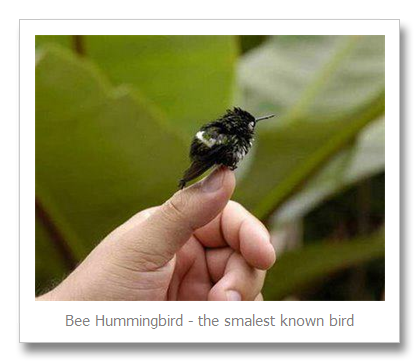
The Ruby-throated Hummingbird is 7–9 cm  long with a wingspan of 8–11 cm, weighing anything from 2 to 6 grams. The species is sexually dimorphic and the females are slightly larger than the males. As in all hummingbirds, the toes and feet of this species are also quite small. The middle toe is around 0.6 cm  and the  tarsus approximately 0.4 cm. The size comparison as shown below against a human hand is noteworthy when comparing the smallest living bird the Bee Hummingbird that is only 5–6 cm and weighs about 1.6–2 grams 

Curtsey; www.tumblr.com
Curtsey; www.a-home-for-wild-birds.com

The Ruby- throated Hummingbird has a migration pattern from it’s breeding grounds in the Eastern North America and Canada to lower locations as Mexico in the winter.


My third trip to Miami with much difficulty did pay off after all; sighting a Ruby-throated Hummingbird  


Monday, April 15, 2013

Identifying Silhouettes


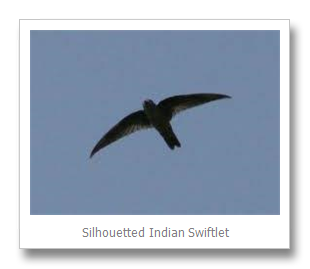
Bird Watching too is not free from assertion ….it is noted that certain birds are only identified by their silhouetted flight profile and one may not see them rested on a branch or sitting on a nest in one's lifetime.

Two such birds have lingered my memory until recent. The Indian Swiftlet [Collocalia uniclor] and the Brown-backed Needle Tail [Hirundapus giganteus] seen just once in September 2, 2002 in the Sinharaja Forest Reserve Sri  Lanka ; just five birds wheeling overhead, silhouetted against a gloomy sky. Never to have seen them anywhere since.

Unlike the Needle Tail; the Indian Swiftlet is a common occurrence all over Sri Lanka and more commoner in the hills. It was also known as the Indian Edible Nest Swift, until the species was split taxonomically. The species occurring in the Andamans and the Nicobars are now named the Edible-nest Swiftlet [Collocalia fuciphaga] while those occurring in the Western Ghats, the Islets on the Malabar coast and Sri Lanka the Indian Swiftlet.


It should be noted that the name change does not indicate the Indian Swiftlet is free from its nest being harvested by man. However it is the East Asian species that is vulnerable and declared endangered as its nest is harvested by man through superstition for its aphrodisiac properties. The refined and processed nest fibers turned into a soup fetches high price and is in high demand.

There has been instances where the Sri Lankan customs detecting nest fibers from Sri Lanka being exported to East Asia, but it is said to be of poor quality  to those of East Asia.

I was lucky  way back in May 2012, to have run into a nesting colony of the resident Indian Swiftlet while hiking in the hill country and was able to photograph a few birds sitting on their nests. They are said to re-use the nests which compensate with time taken to make them anew to the time spent sitting on them, as their feeding and drinking habit is always while on the wing. 


It is for this reason that the Sri Lankan folklore suggest that seeing swifts in large numbers in a cloud laden sky predicts on coming rain. Many swift species drink on the wing and is said to survive prolonged drought. 

On the other hand identifying Needle Tails has its difficulties as well. The needles or extended spines on the tail feathers are seen only when the bird turns in flight and the bird being at close range; so identifying silhouettes is as difficult as identifying persons by shadows.