Wednesday, March 5, 2014

Back to School after 48 Years

It’s a long time since I hung my boots from government service and now serving  a private sector consultancy in Architecture and Engineering. A young colleague working with me on two hospital projects in Hambantota and Nuwara Eliya  is Architect Danajaya Bandara [Dana]; a product of S Thomas’ College Bandarawela and is 20 years my junior. We are of two different eras in the same school. I being form St Thomas’ Preparatory School and him from S Thomas’ College Bandarawela.
The school is now upgraded to a senior school while it was only a junior school then.   
.   
We had been to Hambantota for a meeting and were travelling to Nuwara Eliya when we decided to stay overnight in Bandarawela.  It was obvious and apparent that we both would visit school before getting to Nuwara Eliya on 27th Feb 2014.

We belonged to two different eras at school, the Keble era and the SLA era. However I was more on a transition period. Mr Keble had left in 1956, entrusting duties to Mr Paul Raj . Mr S L A Ratnayake [SLA] succeeded Mr Paul Raj in 1964. SLA developed the infrastructure to its present state from where Mr Keble  left in 1956.

I had left school in 1966...........  but today I enter through an archway that have replaced the large white masonry pillars on which hung two large black swing gates made of steel and timber that were strong and sturdy. It is with  sanctity and high nostalgia that I step in this land which molded me to what I am today. Thanks to those dedicated mentors who cared of us......they need to be  remembered with much gratitude.

There are significant landmarks that have survived the test of time after 48 year.  I keep clicking my camera until it said the card is full…… 

DSCF9515

This is Wijewardane dormitory. it was a single storey building then. The old music room is still at one end of the dorm. It was in this room that we sang along with Ms Blanchard, Ms Marshall and later with Ms Sarathchandra the former wife  of late Prof Ediriweera Sarathchandra.

On the other end is the Corea dormitory which is the same old single storey building. The flowerbeds on the opposite side of the road are no more, probably to accommodate two-way traffic. It was only the Headmaster’s car and Rev:Father Jeerasinge’s Skoda that plied this road then.

DSCF9560
The Corea dormitory  looks the same even after 48 years. The rainwater harvesting  tank at the corner of the dorm is still serving as a collection pond. I could remember this tank as a tiny tot. It was as high as my chin then, which is not more than 2’ 6’’ tall.
.
DSCF9517
It was this water that served as our bum wash, when the water ran dry in the faucets. The  old loo house in Corea,  still has those ledged braced and battened doors. The typical timber door detail that we drew on our drawing boards back in the first year at university for engineering drawing practice in building construction.


DSCF9519

The embankment behind the kindergarten building alongside the small play area that held the two swings and the see-saw still looks the same. The play  area now holds a building. The tiny driveways that we carved into this embankment forming a mini Khyber Pass where we played with our Dinky Toys on Sundays have all but got washed with time. Present day boys hardy play with Dinky toys anymore. Times have changed.

DSCF9520
The open Arena during the Keble era is replaced with a kindergarten play area.

DSCF9561

The pathway down to the spout where we went for our weekly bath is now cemented. Boys do not bathe in the spout anymore and the waterway is not rich as then. The large buttercup trees that lined this path have gone. We collected the tiny buttercups that dropped after flowering on our way to the spout.


 DSCF9521

The dinning hall is the same old building but the partition that separated Ms Unambowe’s tuck shop is now incorporated in the dinning area. The blue Formica laminated long tables are still existent. The brown benches are now blue. I recall the mealtimes where Ms Janze  and Ms Luduvyke supervised us. Everything on the plate was deemed edible. There were times when murunga and mellum was found under the table and all in that table were punished. We were not of the habit of taking goodies from others’ plates  but loading them with the unpalatable stealthily.

DSCF9565
DSCF9564

The old trophies from Mr Keble's hunting trips that decorated the dining hall walls are no more.The old school photos that lined the top rail on the walls from 1948 onwards are still there. The indelible ink writing on the 1948 photos have stood the test of time.  The floor has the touch of the new trend; ceramic tiles.


DSCF9522
DSCF9557 

The ground in front of the Blanchard dorm is still spacious where the scouts of  Gurutalawa  had their campfires when they camped here with Rev: Father Goodchild. This dorm too has grown taller and it is sad to see A/C comfort needed in Bandarawela now. The dhoby days are gone; get the feeling that the soiled linen is washed within in machines and dried on the fence.


  DSCF9525

It is with great reverence that I stood here still; my head held high looking on at the old school crest on the gable forming the portico where the Headmaster parked his car. Also it is rewarding to see this piece of legend not replaced when the School became a Collage and changed its motto from ‘THE LORD IS MY SHEPHERD’ to ‘ESTO PERPETUA’. However it is sad to see this view distorted by the roofed stair way.  I feel it is unnecessary here. It was SLA who roofed the pathways from the dorms to the dining hall.

DSCF9529

DSCF9537

The red trapezoidal walls holding the canopy over the entrance to the corridor of the main building near the old school office is still intact. Not much change in the classrooms of yesteryear. The old Tamil medium section is still seen in the rear of the main building probably used  for other purposes now. The lodging house of the  office aid cum school supplier who rode daily to Bandarawela on the Humber delivery bicycle whose name I forget is  now a workshop.

 
DSCF9539

The most pristine piece of architecture of the old school was the little chapel that came up during Mr Paul Raj’s period. The construction of it was a great experience to us. The building premises were out of bounds to us but we stared at the busy workmen going about their daily scores from an allowed distance. The chapel was later added with a belfry outside in the garden. We non-Christians were very much the choristers then
.
We had morning prep in the class rooms and were allowed outside of class to recite Sinhala Kavi and English Poetry loudly in order to memorize and recite byheart when in the class. This loud recitation was allowed  behind the chapel as its granite walls would buffer our loudness to those studying in the classrooms.

The need to be outside of the prep class was not mainly to byheart kavi but to catch the morning sun to rid the severe cold that prevailed towards the year end. We used to sit at the chapel doors or in the drain edges catching the morning sun but occasionally being punished for chatting while sunning.


DSCF9555
Dana with me at the Chapel

DSCF9541
DSCF9540


The doorsteps and drain gullies where we sat sunning

Panorama6


A new upper school building complex has come up alongside the chapel to match with the architecture. 


DSCF9559

It was very sad to see the play ground that had a green carpet of grass bare of it now. The old pavilion building looks ancient and dilapidated. The roof has had a new cladding but for the building.   

DSCF9563

The games viewing benches done in 1965 by SLA was a novel idea making use of the embankment. The benching has now been extended. This may have had a negative effect in upgrading the old pavilion.

DSCF9514

Finally the landmark building of the school, the Keble Memorial Hall designed by yet another old boy  late Architect Lala Adithiya stands solid at the entrance to the school. The work on the land leveling for the building commenced in my last year in school, 1966. SLA was very instrumental in  organizing many fund raising activities to raise the cost of construction. We boys carried brick cards home with each brick named after the wardens and dignitaries associated with S Thomas’ Colleges and Schools. If I remember right a full card collected 100 rupees. This was quite a sum then. The monthly school bill would also be around Rs 120 then. Madduma Ratnayake's family contributed with machinery for the land levelling while M Y Hemachandra & Co was the building contractor, another parent.

DSCF9566   The Keble Memorial Hall

We met three present day teachers Mr Denzil, Mr Bandara and Mr Lal who were very generous in serving us tea. They were impressed of my narration of how the school was then and of the letter writing that was mandatory on Sunday. Today it is the mobile phone that contact parents. Times have changed.

We discuss about school running now. One significant change seen today is the number of day scholars have exceeded the boarders. Get the feeling that priorities have changed from a boarding school to a day-school. This is reflected from the playground being bare of grass. It was here that we spent much of the evenings with Mr Markandan the Games Prefect. The grounds do not seem a priority anymore.

We discuss about any assistance that we could provide on engineering and architectural expertise. The need for developing the pavilion was a requirement, both Dana and I would like to look at it seriously.

It was a memorable visit for me and this writeup is for all of us who passed-out from this institution, and are indebted for all that we received. 

Sunday, February 23, 2014

FOGSL Camps in Gal-Oya

Gal-Oya a rivulet in the eastern province of Sri Lanka is a perennial source of water originating in the luscious forested tea country of Passara located in the wet central massif. 

The Gal-Oya Valley Development Plan was the first multipurpose development scheme of post independent Sri Lanka. Irrigating the dry parched lands of the Ampara District and generating 11MW of electricity, a considerable wattage then in the year 1949. The main head-works of the project commenced in 1949 and was completed in 1954 damming the Gal-Oya between two significant hillocks, at Inginiyagala, a very small township even to this day. The dam was then known as Gal Oya dam or the Inginiyagala dam, and is now named the Senanayake Samudra [sea of senanayake] in honour of the islands first Prime Minister Hon: D S Senanayake. It’s got a total storage of 770,000 ac-ft. when the sheet of water is 35 sq. ml.
An important feature of the project is that, much of its dry zone catchment is declared a National Park, that was administered by the Gal-Oya Development Board until 1965, the year it was handed over to the Department of Wildlife Conservation. Gal-Oya National Park is famous for its elephant herds that can be seen throughout the year. Its vegetation is of three types; wet monsoon forests, dry shrub forests and savannah lands. Three important herbs of Ayurveda medicine the Tripala - Aralu-[Terminalia chebula], Bulu-[Terminalia bellirica] and Nelli – [Emblica officinalis] which is thought to have been grown from very ancient times is found abundant in the savannah land.

Field Ornithology group of Sri Lanka [FOGSL] conducts an annual bird-watch within the Nigala Sanctuary located in the savannah land of the Gal-Oya National Park, a noted habitat of the Painted Francolin [Francolinus pictus]. This year too it was scheduled from 13th–16th February 2014. However due to logistical needs of the wildlife authorities the bird watch was shifted from Nilgala to Kossapola camp site located within the park in a wet monsoon forest habitat. 

Everything on this trip was different. We left Colombo late in the evening on 12th Wednesday to reach the Nagala temple in Bibile in the wee hours of an unusually cold night. Dinner was had on the way with elephants encountered around Randenigala. Napping was only for three hours at the temple, and we commenced travel again by 7.30 in the morning. Some of us suggested we travel direct to Gal-Oya. This was not possible as we had to collect the cooks and their pots and pans on the way.
The cooks with their pots and pans collected and breakfast had on the way we reach the Gal-Oya park office around mid-day. With the ticketing done and the provisions collected we reach camp alongside the reservoir around 1.00 p.m. for a packed lunch. From here on everything was to a plan; a strict self-set ruling that was to be practiced by every participant. Safety was an utmost in this elephant country that was evident on the opposite bank of the reservoir; over 50 ele’s grazing together with the Thamankaduwa White cattle a symbol of the livestock in the Eastern Province. We were set into three groups of eight for birding and the birding boat ride each day at 2.00 p.m. in the reservoir.

Day One: 13th February 2014

 
Being almost three hours behind schedule, the priority was to put up tents. Five tents came up in no time with masculine help for the two ladies tents. Group one was on its way to Inginiyagala for the boat trip by 2.00 p.m. The other two groups had a special task to be performed before birding around the campsite. The general water use in the single loo house available was by filling a cement tank built besides it with water from the reservoir. The reservoir levels being 42 feet below spill level, the water line at the campsite was about 500 feet away. The filling of the tank and collecting firewood for the campfire that burned through the night was mandatory. The tank was filled with all available buckets and pails passed from hand to hand, with each person standing almost 30 feet apart.

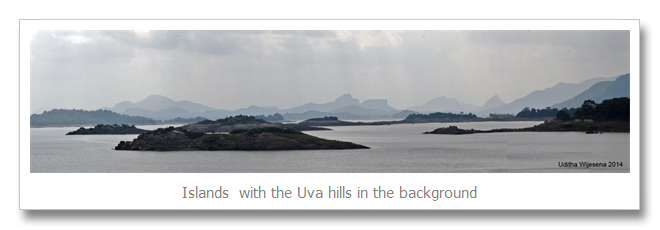
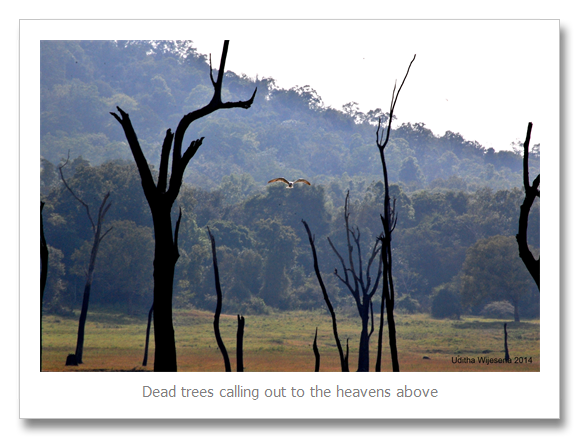
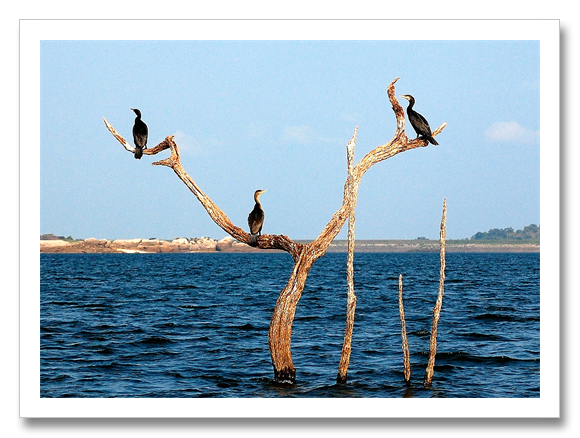
I was on the boat trip the first day. The jeep took us to Inginiyagala with the empty cans for drinking water to be collected from the Wildlife Office on the way back. We are on the reservoir bund looking across the water until the boat is readied. It’s a splendid picturesque view of the Uva hills beyond the numerous islands the reservoir has created when inundating the landscape and the forest. The large trees that were marooned in this sea for 60 years are but now dead. The hard wood with its branches stand out of the water like arms reaching to the heavens above grouching for the plight they had to meet with. They now sever as roosts for the multitude of water birds. This wood would not be standing so in a present day reservoir. The demand for timber will fetch them all for commercial use. It would go waste otherwise.


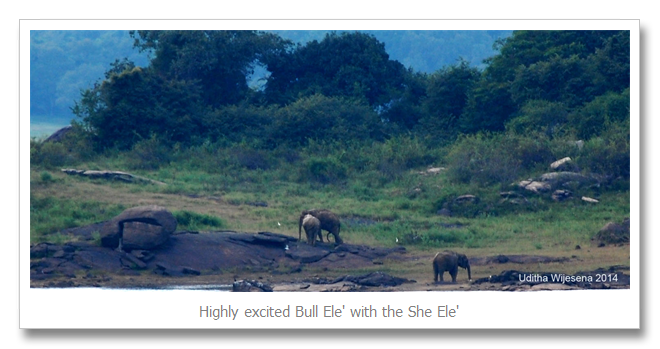
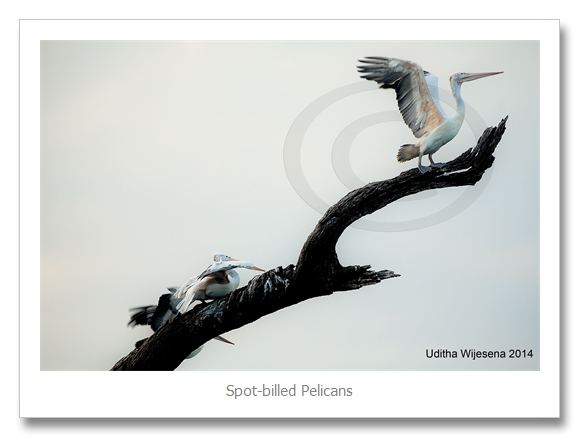
Beyond the water I spot a highly excited bull elephant in the company of a she elephant, away from the herd; a courtship in privacy. What more… it is the lovers week with only a day to go for the Valentine’s Day. The boat is ready and we are all on board and away. With the water low we do not see many birds but elephants…… The Greater Cormorant that Gal-Oya is famous for was there with the White-bellied Sea Eagle and the Grey-headed Fish Eagle. On the way back the Spot-billed Pelicans were seen roosting on the dead trees. Back in the jeep with the drinking water and two more participants who came on their own, we return to camp. The loo water is filled and the camp fire burning high we go for a dip in the reservoir on a moonlit night. Back at camp the bird list for the day is done, dinner of boiled rice taken with fresh tilapia from the reservoir. Everybody is tired and retires for a good night’s sleep with the camp fire now burning low.


Bird of the day….White-bellied Sea Eagle.


Day Two: 14th February 2014

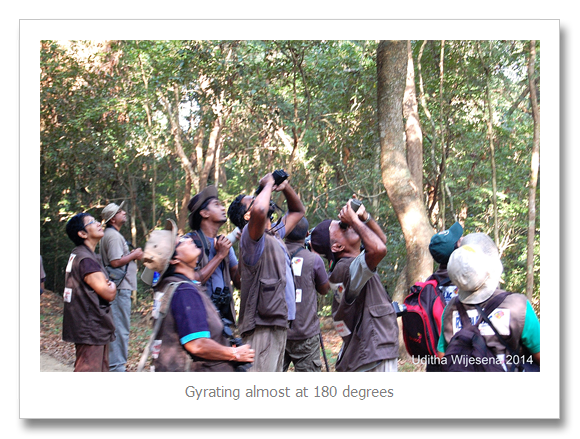
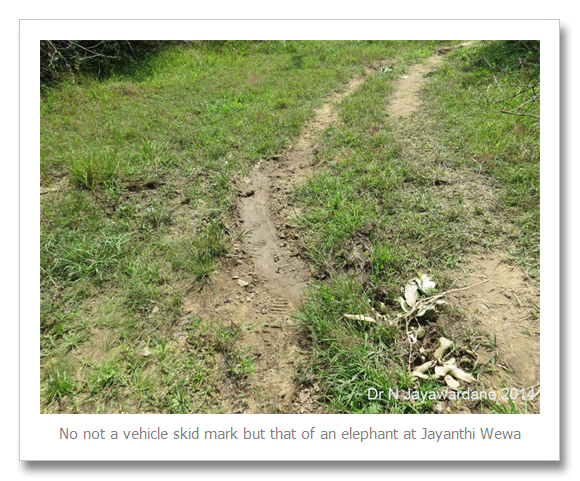
The cooks are the first to rise; then the ladies around 4.30 a.m.… on to loo business before the men folk. All are up and ready by 7.30 a.m. after a sumptuous breakfast of rice and dhal with leftover fish. We are to venture into the jungle, a distance of 12 km up and down to Jayanthi Wewa, a water hole within the forest. Clad in the FOGSL camouflaged jackets we look like commandos in for jungle training. The tracker Nalinda briefs everybody of the journey through the forest. He would be leading ahead of us looking out for ele’s. If seen, he will signal us to retreat. No one is to panic. We follow him, armed with two thunder flashes. The forest is dark with only the high canopy lit up by the sun, where the bird activity is to be. We are straining our necks gyrating almost at 180 degrees to look through the binoculars. It is easier to identify birds by their call in this type of forest. There are no mixed species flocks as in the wet zone rainforests. My ability to identify much of the calls and the field notebook replaced with modern day digital camera and zooming lenses we identify most of the birds high up in the canopy. It enhanced my knowledge of bird calls as well. If you hear a call similar to that of a Tailor Bird in heavy forests like this, but on a slightly lower pitch it is that of the Bar-winged Flycatcher Shrike.
Also much of the birds here are very drab in colour compared to those in the wet zone. The Black-napped Monarch is not in its Azure Blue over here and is mistaken for other birds. We head back from Jayanthi Wewa located at the foot of a hillock named Vadinagala with nothing significant seen on this hike excepting for the Rofous-bellied Eagle; that too was identified thanks to the shutter bug who was fast enough to click while it passed over the road clearing. The only window for a sky view in this type of forest.
Back in camp the kitchen has come up complete with a table made of jungle stakes for the provisions and the cooked food. There were two pits one for the wet waste and one for the dry waste as in our scout camps back in collage. The lunch seemed special this day…we held our plates to the cooks who served us boiled rice with smoked tilapia, curried banana floss cooked to taste like young jackfruit and a melluma [pan stirred finely chopped greens with shredded coconut]. It was yummy…..everybody had a second service and inquired of the green that had a peculiar bitter and slippery feeling on the palate. I being a man often into the forest and seeing the residue of the plant in the dry pit, it was Welpenela [Cardiospermum Halicacabum]. It’s an herb reportedly good for general body aches, with aphrodisiac properties. A large pan of it is now empty. Many would have been complimented back at home for sure…..?
 
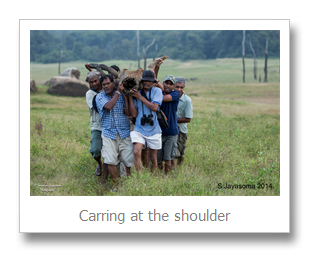
The group two leaves for the boat trip. It is our turn to fetch water and the fire wood. We are lined up in the blazing afternoon sun passing buckets of water when my good friend Amudesh thinks it is a non-productive exercise and opts to have a pingo pole through the handles of the two large pales in the kitchen. Four rounds of the large pales carried pingoman style fills the loo tank to the brim. The job done we decide to climb the rock on the opposite side of the water and wait for the ele’s to come out. Day two was not for the elephants and we decide to walk back to collect the wood for the fire. Someone suggested we carry one large tree stump from the reservoir and that should burn throughout the night. What a bright idea …..We try to lift a 60 year old stump only to find it still in tack with one root. Toiling with it we managed to dislodge the root and someone said it smells the almirah at home. Yes the root was still fresh emanating the smell of satinwood timber and was heavy as lead. Now to get it to camp we started rolling it awkwardly when Amudesh stepped in again and suggested we all get together and carry it at the shoulder. This was no easy task when we took it to the shoulder. The ladies felt sorry for us and suggested we leave it and fetch smaller timber. …..I heard someone say in a painful tone…. “No no we need to take it away….the elephants might trip on it.” The satinwood stump burned through the night giving us warmth, light and protection.


The boat team is back they too have had not much luck with birds but seen an elephant swim back from an island to the mainland. The evening dip taken, the bird list for the day done, we retire tired after dinner.

Bird of the day…..Rufous-bellied Eagle


Day Three: 15th February 2014

We are to go in a different direction today; a circuitous route that would bring us back to the base camp passing the Diggalamulla campsite. We see the same birds as the previous day excepting for having startled two Sambur Deer in a nearby thicket while following forest wagtails and a lonely Jackal with a colourful coat scavenging the reservoir plains. 

The boat team had had a chance to alight on to the mainland where they had seen the Malabar Pied Hornbills. We at camp spot a progeny of the Ceylon Painted-lip Lizard [Calotes ceylonansis] an endemic species which is totally arboreal and found only in these wet monsoon forests. 


The elephants are back on the opposite bank. A full herd with calves are seen cooling off the blazing heat and covering themselves with a coat of fine clayey sand extracted from the bank as a skin protection, displaying themselves as true ‘White Elephants’ or albinos.
Today we do not need that much water as we are to leave early the following day and the fire wood that we had collected for the kitchen was sufficient to keep the night alight.

The final bird count for the three days was taken. It was a total of 99 species seen and heard. There would have been many more birds for sure. It is the type of forest cover that prevents us from seeing them. One needs to stay longer in such locations to get a full count of the birds. We had recorded over 180 birds in the adjoining Nilgala savannah in the past years.
Retired for the day, many of us are woken in the middle of the night to the rumbling sound of an elephant from behind the camp. We flash our torches in the direction of the sound and all seem to be calm again. Trying to catch sleep again we hear a totally different sound this time from the shrub close by. It’s the call of the Slender Loris. We try to locate it with infra-red lights and flash lights to no avail. We go back to sleep with the intermittent chee…….chee……sound of the Loris. Tomorrow we go back home.

Bird of the day…..Grey Headed Fish Eagle.


Day Four – 16th February 2014

The cooks are up very early. They have prepared the breakfast and the lunch was in packets to be had on the return journey. The departure is planned for 8.30 a.m. and we are delayed as the tents need to catch sunlight to rid the night’s dew. The last bird to be seen was the Orange-headed Thrush behind the large rock at the campsite .
The tents are down and are now packed. We are off at 9.30 a.m. after a group photo taken with cooks trackers and all, a big thank you and goodbye to the cooks and the two trackers Nalinda and Wimale who accompany us up to the Nilgala turn off. 

We reach Colombo by 9.30 p.m. A memorable four days and four nights that would linger on as life goes by …. with nostalgia.