Saturday, January 4, 2014

The Mist-laden Morningside of Sinharaja

 
Sinharaja Forest Reserve is the largest rainforest landmass [22,000 Ac] of a series of fragmented rainforests in the South-west of Sri Lanka. A biodiversity hotspot with an international significance; Declared a Man and Biosphere Reserve, and a World Heritage Site of the UNESCO. It’s got three access ways; the Kudawa entrance via Kalawana with Pitadeniya and Morningside entrances via Deniyaya and Rakwana respectively.
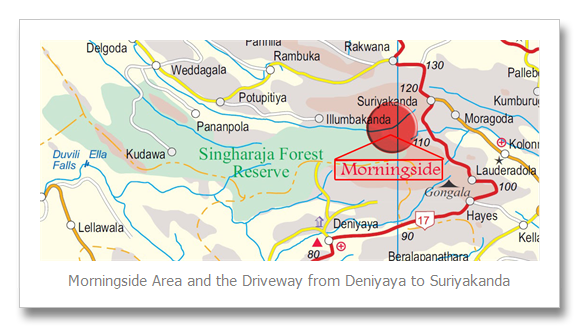
The Morningside area is special for it has a biodiversity of its own compared to the rest of the forest. The climate is wetter and the secondary forest is mist laden throughout the day. Bird species generally found at elevations over 1000 meters occur here while endemism both in flora and fauna is thought to be very high. This land having been opened for tea in the colonial era is now a regenerating secondary forest running abreast with very productive tea lands located between the forest and the driveway from Deniyaya to Rakwana.
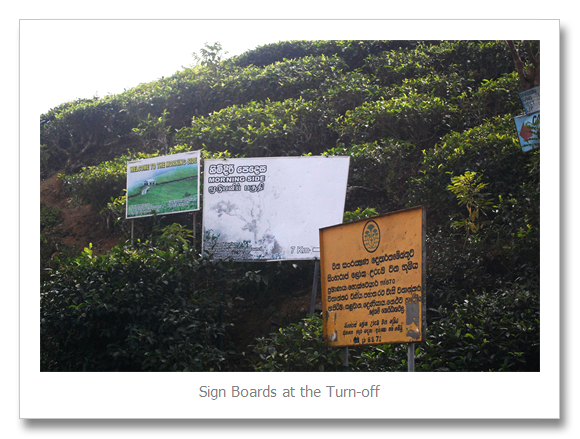
The popular belief is that the name Morningside was coined by the colonial planters of the Lankaberiya Estate who named this section of the plantation as the Morningside Division, owing to the misty and gloomy climate, signifying the morning in the hill country. Thus the Sinhala translation; ‘Himidiri Pedesa.’ 

However it means otherwise to me. The term Morningside in the English language is generally used in reference to hills and mountains. The sides of a mountain is described as the Morning-side and the Twilight-side based on the falling sunlight due to the earth’s rotation about its own axis. The Morning-side of a mountain is always shadowed in the evening. This particular land being located in the east most part of the Rakwana range is the Morning-side of the range. However the Sinhalese term Suriya Kanda [Sun Hill] is appropriate for its position in the east most part of the range. [Re: popular song by Donny and Marie Osmonds’ in the 70’s http://www.youtube.com/watch?v=TzXtvhaKTPI

Three of us Wilson, Amudesh [Amu] and me have been ardent birders together for a long time. Amu had a three year long urge to visit Morningside of Singaraja which realized only on the last weekend of 2013. We planned an overnight stay at the Deniyaya rest house which was overbooked, and settled for a guest house in Deniyaya instead. With the bills paid up in full before retiring on Saturday night, we would leave very early on Sunday to cover a distance of 40 km to Rakwana aiming to be at Morningside by 7.O’clock in the morning. 


This 40 km drive from Deniyaya to Rakwana through the tea plantations of Hayse and Lauderdale Estates is one of the most picturesque driveways in Sri Lanka. Throughout it is a series of hills [Kanda–in Sinhala], starting from Anin Kanda to Panil Kanda, Buth Kand, Iththa Kanda and the last being Suriya Kanda; our destination. The turnoff to Morningside is on the 113th km from Galle. 

A monument done in 1941 to mark the opening of this road linking the Southern and Sabaragamuwa Provinces is still to be seen alongside the driveway. The bronze lettering on it is all but gone; vandalized for the value of the metal leaving the perforations that held the letters for one to read along. It is interesting to note that this monument also denotes the district boundary of the Pelmadulla and Matara Districts way back in 1941. Today there is no such district as Pelmadulla but Ratnapura.

The gigantic Gongala mountain massif protruding from the Rakwana range is seen for miles at every turn on this snaky road. Wilson says Gongala resembles a bull’s hump. To me it is so complicated, I am one who is yet to visualize the lunar rabbit on the moon surface. We stop at a wayside kiosk for homemade hoppers [not the razor sharp rimmed type in the city] and koli-kuttu bananas with much plain tea. Buns were packed to be had on the way.
We arrive at the 113 km turn-off passed 7 O’clock but is good enough for birding. This bit of road which says is a 7 km distance to the Forest Department bungalow is but suitable only for an off-road vehicle. A small truck lorry is the ideal. It is a shear climb winding through tea country partly stone paved and partly concreted. But the tar macadam of yester year is still visible hidden under the grass in certain sections. 

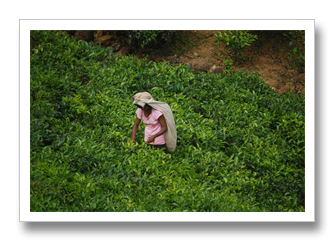
The car comes to an obvious stop where the road was wide enough for a passing vehicle. We have no choice but to hike. Wilson, who braved the Asian Tsunami in 2004 at the age of 68, finds the going too tough a challenge and decides to stay back. Amu and I decide to hike the distance of 7 km. We pass along encroached tea cultivations where some encroachers live on the land while most come from far to work the land and go back home in the evening. Mid-country tea fetches high prices and is a very lucrative business. The higher we trek the tea is thinned and the misty mountain immerge. Not a soul in site, its dead silence if not for the forest birds and the occasional cicada.




I recall the hikes in the hills during school time. A very tough one in 1969 when we hiked from Ella to Wellawaya finding our way by the surveyor’s pegs marking the trace of the present day road from Wellawaya to Ella. The camping trips to Yala and Lahugala where we learnt tracking. Rev Father H C Goodchild [Goodie] who organized these outings would tell us ‘ now look here you rascals keep your gaps shut and your eyes, ears and noses open when in the forest’. These were practical lessons to see what had taken the road before us; identifying through pug marks of the various fauna and their scats etc. Goodie’s teaching and the pranks we played with him for momentary annoyance years before came rushing to my memory when I showed Amu the wild boar harrows of the night before and the ant-eater [Pangolin] that had dug into a crater of the black ants in the middle of the road. The pug marks of a Jungle-fowl or Spur-fowl. The strong scent of urine in the isolated jungle patches in the ravines where the Sambur Deer has marked their presence and territory. Both sexes of this species depend considerably on the olfactory cues, during their various social behaviour.


Half way through a lady emerge from a short cut and said she was on her way to an old plot of land once part of the tea estate now vested in the forest. A bungalow with the roof off is still to be seen within, with the forest closing in from all direction. She still harvests the cardamoms that now grow wild in this area.


We keep trekking with the bird-watching; the research station of the Forest Department seems so remote. At last we reach the research station; its 30 minutes to noon, we’ve taken three hours to come here. The sun at its highest and the land is still cloudy, misty and gloomy. The buns and Arabian dates give us the lost energy to trek back listing to the Malabar Trogon, the Sri Lanka Hornbill and the Spot-winged Thrush. The most looked for bird over here the Yellow-eared Bulbul was seen just at the edge of the forest. Three of them; the bird of Nuwara-Eliya and the Peak wilderness occur here in a very strange manner. So is the endemic Dusky Blue Fly-catcher. It was pleasing to see much  Purple-face Leaf Monkey on this part of Sinharaja.


On the way back we descend directly through the tea plantations cutting short the time and meet up with Wilson who had seen all the Prinias and a host of Yellow-fronted Barbets and the Black Eagle.
Our timing for the return trip was just right as planned. A late lunch was taken at a wayside kiosk. On inquiries if lunch was available for three; the lady was reluctant to say that she could provide us lunch, but without any meat or fish. We were most obliged with the dhal and breadfruit curry with the greens accompanied with red rice. She was not happy though and decides to serve us an extra portion of onion salad and deep-fried sprats that was prepared in a brisk.
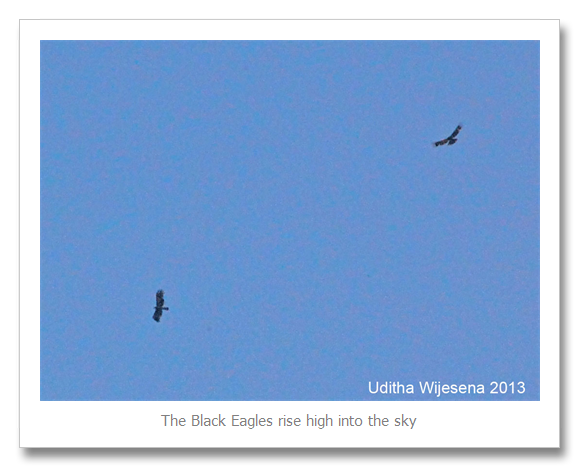
Relaxing before the drive back to Galle after lunch at the kiosk, the Black Eagles immerge once again and they swoop down so low in their courtship ritual, exciting the stray mongrels that give chase sending them high into the blue skies. That was to be the finale of Amu’s memorable trip to the Morningside of Sinharaja that took three years to realize. A very worthy one though with a strenuous climb of 7 kilometres.

Tuesday, December 24, 2013

MANNAR …where the Donkey Sleep Standing and Birds a Galore

 
Many of us from S Thomas’s Collage Gurutalawa [STCG]; a school in the central hills of Sri Lanka are fond of out-bound living and are very much into Bird watching. Professor Sarath W Kotagama was one who made ornithology his profession at the Zoology Department of the University of Colombo. He pioneered the forming of ‘The Field Ornithology Group of Sri Lanka [FOGSL]’ in the year 1976; to promote awareness of bird conservation to the masses and in return to get their assistance in the scientific study of birds.

Areas outside the north of Sri Lanka have been studied of birds and much of the birding locations identified. It is only now that the localities in the north of Sri Lanka are being reached for birding.The 30 year civil war prevented access to the north, until 2009. FOGSL has now expanded its bird research activities into the Jaffna Peninsula and the District of Mannar.


FOGSL has an annual birding calendar to identified locations. The Mannar bird count for 2013 was scheduled from the 13th -16th  December 2013. 

We left Colombo in the early hours on Friday 13th with stops for breakfast at Waikkala and lunch at Anuradhapura. Thanks to the better roads after the war, we reach Mannar by 2.30/3.00 in the evening. Accommodation had been organized at the Army’s 54th Division HQ in Mannar. We unload our baggage to a typical boarding school dormitory with bunk beds. The six ladies in the group were also provided accommodation in bunks but separated by a board partition. My memory ran back 40 years to my boarding school and opted to sleep in an elevated position. Settled down with bag and bedding we decide to waste no time with birding. We had a list of specialities to be seen on this trip. After a cup of tea we leave the camp gates towards Poonarin for an hour or two before sun down in order to judge the potential for birding during this time in Mannar. 


Leaving the 54th Division gates I recall the warring times; it would have been through these very gates that the valiant forces lead by Brig Shavindra Silva marched out in 2007 to rout the LTTE in 2009 

The two hours of birding was a great success and was an indication of what was on line for the three days. We had seen Wigeon ducks, several species of Bitterns a few Raptors and some forest birds. The Black Drongo native to Mannar was everywhere and the migrant Long-tail Shrike is so common here compared to the south. The listing for the two hours in the evening was 63 bird species. 

Back in the dormitory with some overenthusiastic members suggesting a walk to the Mannar causeway to see the Crab Plover through torchlight was never fruitful. We settle to a sumptuous dinner of boiled rice with curried fresh fish and other accompaniment and retire early to bed for we are scheduled to set off by 5.30 in the morning for birding. It’s the time when they are most active.


Up by dawn we leave for the Vankalai plains for birding along the newly laid railway line still under construction. Just as we get off the bus a family of Grey Francolins are startled and run among the bushes. Not far was a Eurasian Curlew displaying to the shutter bugs. My spotting scope captured much; the Northern Shoveller, Eurasian Wigeon, Northern Pintail and Garganey of the rarer duck species with plenty of the Whistling Ducks seen.

The migrant harriers were so abundant. The Montague's Harrier and the Marsh Harrier with the Common Kestrel hovering on the wing, stalking for prey below. A variety of the Plovers were seen with the migrant Shrikes; the Long Tail, Brown and the Philippine seemed so common over here. Returning for breakfast we stop at the Thalladi pond opposite the camp for a prize sighting of a solitary male Spot-billed Duck among a few Garganey. Again at very close range for excellent pictures to be taken.


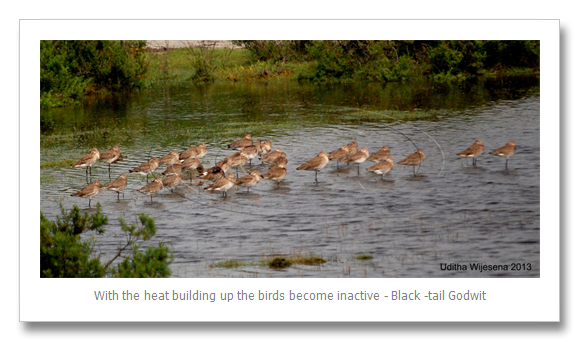
After breakfast we cross the causeway to the main Island of Mannar the township. The causeway is a heaven for all species of Egrets and the rare Western Reef Heron. Having seen all of them we proceed to the Mannar saltern. The ‘look out for’ bird was in plentiful….. the Greater Flamingo. Over 284 birds were counted in two locations in the saltern in close proximity to habitation. Of the Gulls, the Heuglin’s Gull, Greater Black-headed Gull and the Brown-headed Gull was in their numbers. With the sun at the peak of its trajectory the birds become inactive and so are the many stray donkeys that sleep standing. We return to camp for a late lunch only to leave by 3.00 in the evening to see them fly back to their roosts for the night. 

The evening was back to the Vankalai plains and the Vankalai pond. The ducks seen during the day were now leaving for the night in the traditional ‘V’ formation. On the way to the pains a special bird that had raised concern and confusion sometime back was thought to have been sighted; The White-headed Stilt? We come back for the night by traversing on the causeway again looking for the Crab Plover with no luck. Just at the camp gate to everybody's surprise we see the Crab Plover trotting in shallow water in the lagoon. It was definitely an exultant way to end a very productive day of birding.
Back at camp we run through the list of sighting for the day which went up to 99 species. We retire for the night with a programme to go looking for the elusive Indian Courser confined to the Mannar district the following day.

Up again early we leave for the Vankalai plains by 5.45 but with lesser sightings than the previous day. After breakfast we leave for Vedithalathive where the LTTE’s sea tigers were very active then, also the location where our special bird was to have been spotted recently. A distance over 20 km we are at a vast marshy plain stretching for over a kilometer. Harsha the sharpest spotter in the group says he sees a dark orange patch moving in the distance. Yes… with the aid of the spotting scope we see three Indian Coursers in the distance. Some of us decide to stalk them once everybody had seen the bird through the spotting-scope. We brave the sticky mud where landmines had been cleared to get a closer glimpse of the bird. It was a beauty through the binoculars. A stray dog attracted by our presence startled the birds into the air and they were no more. This was a lifer for me [seen for the first time] which was celebrated with Elephant House ice cream to the whole group. I’m sure many of the birds seen were lifers to most in the group though?


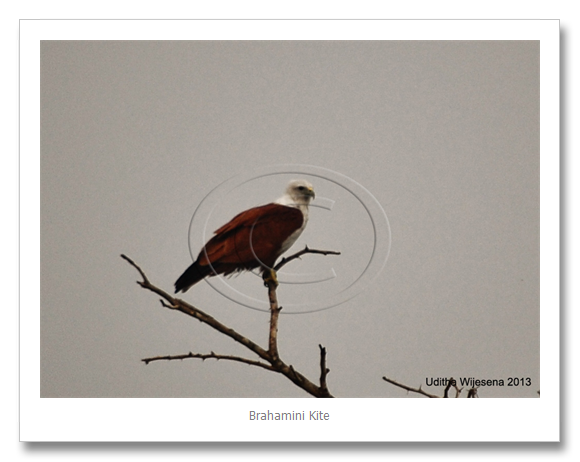
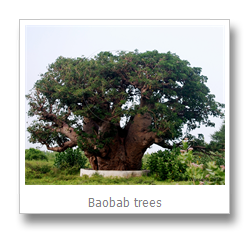
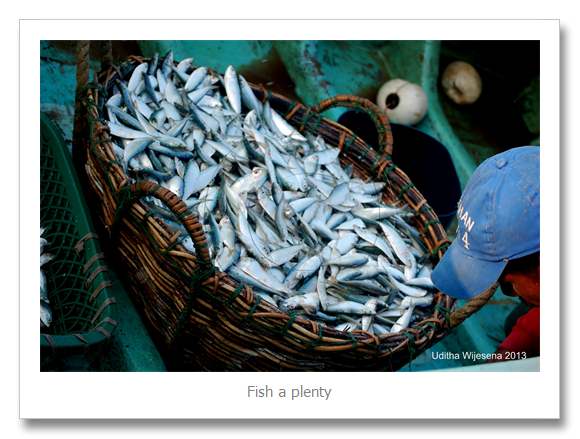
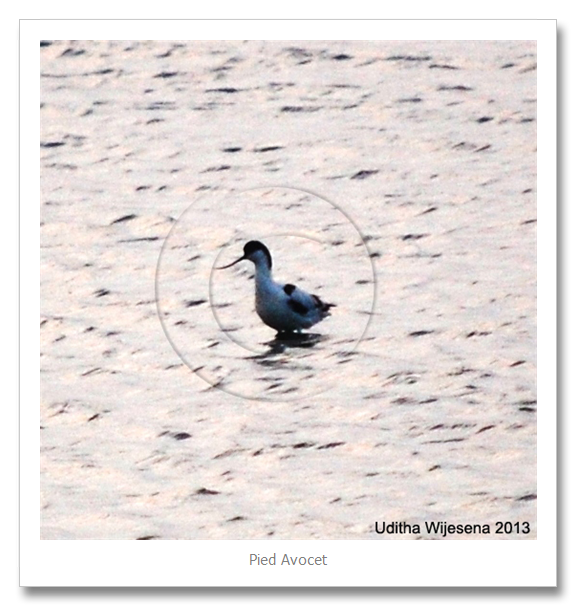
The evening round was to the Talaimannar Pier for the Gulls. On the way we stop close to Pesalai looking at ducks and wild horses and a number of wildly growing Baobab Trees introduced by the ancient Arab traders who brought camels here for trading and transport. The Baobab is said to have been planted as fodder to the camels. The camel is no more but the Baobab and the horses brought by them have gone wild. We see numerous gulls and egrets at the pier with so much fish caught going waste providing food for them. The Black Kites and Brahmini Kites have to brave the harsh wind to scavenge the beaches. While at the pier we get news of a solitary Pied Avocet in the saltern; and we rush back to see it only silhouetted in the fading light. I promise the group that we come early tomorrow and we would see it in brighter light. The third days come to an end with 113 species sightings. 


Come the following day we leave early for the salterns; as promised the Avocet was there for all the shutter bugs to click away. Another special that morning was the Terek Sandpiper with its upturned beak. We come back for breakfast before leaving to Colombo with a stint of birding over the bund of the Giants Tank with one more new sighting of a Yellow Bittern brought our list up to 120 species in three days. A very productive bird count, which would have been a total success with the Oyster Catcher and the Common Teal seen.


FOGSL has been into this type of outings with basic scientific study for the last 38 years. The membership that had benefited from it runs to over 3000. The message is firmly passed on for sure, as seen by the enthusiasm shown by the participants on this trip. However I am thinking if we are the same as when we started research back in the 1990’s. Today I see more photo happy birders than the real birdwatcher of the past. It’s nothing to be alarmed of though in this materialistic world…. where everything is being commercialized?