Sunday, July 13, 2014

Spring is over; it’s Summertime

It’s a Saturday morning in the month of July and I'm still in bed at home in Galle; a township deep down in the south of Sri Lanka…listening to the morning melody of the birds in the garden calling me out of bed… they all seem to say; ‘gone are the rains and sunny days are back.’ 

This year the monsoon rains were very much on time unlike last year. 

Yes I know it’s going to be a bright and sunny day as it’s been a long time since my bedroom wall caught the morning rays that stream through the windowpane. I’m still lazy though when I hear a unfamiliar call….not heard before in our garden and I’m sprung out of bed into the garden looking for my new feathered friend. My guess was right it was the Black-headed Cuckoo Shrike calling high up in the mango tree [Mangifera Indica]… it was a male bird whistling a high pitched, wheep-wheep-wheep while hopping about in the brightly lit canopy
.
BhCS
Black-headed Cuckoo Shrike

Ehela
A riot of yellow - Ehela in bloom
Happy and content with the new found friend I wonder about in the garden. It’s high activity all around. The parched and dry weather in March-April, that wilted my three Ehela trees [Cassia fistula] forcing them to drop every leaf and bloom out into a riot of yellow is now a deep green. The monsoon rains that followed have triggered off new life into them and are now adorned in new foliage. The Black–hooded Orioles are busy in them staining their black hoods in odd angles looking for grub. The Ehela trees are ready again to host the larvae of the Lemon Emigrant, and the Common Grass Yellow, the two butterflies that prefer the Ehela to lay their eggs. Very soon the fresh foliage will be chewed up by the larvae and the Orioles and the Bul-buls with the Magpie Robins and the Tailor Birds will be feasting on the fattened larvae before they go into pupa. 


Foliage
A deep green
Oriole 1
Black-hooded Oriole
Oriole 2


There is more activity in the shades among the Anthurium’s I see. Approaching them stealthily I'm almost in touching distance with three fledglings hopping about in the sand calling out to the parents who keep feeding them constantly. My wife Hemamala joins me and inquires as to what they are. “They are Magpie Robin chicks” I say to her disbelief. Yes the chicks have mottled beast feathers that fade away in adulthood. The Magpie Robins have had a successful brood this season with three chicks surviving; thanks we do not have a feline pet with us now.”


MR 4
Exploring the surround
MR 2
Magpie Robin chicks with mottled breasts
Earlier on inside the weep-holes in the stone wall opposite our bathroom fanlight, nested the White-breasted Kingfishers. They too were successful this year as the rat snake that inspects these cavities for cleanliness was a late comer this year. I now see four Kingfishers flying about in the garden. 

DSC_1018
The bathroom fanlight a hideout for photography
This is the cycle of nature that keeps going year round in this little green patch that we maintain around the house in Galle; a 14 perch housing block. What a friendly atmosphere and I get the feeling that all these feathered friends take time off to thank us every summer for helping them keep their progeny alive year round.

WP1
Black- rumped Flameback
Just as I was about to go into the house, I hear him thanking me in his own special way. Yes the Black-rumped Flameback is on the mango now and is drumming away for me, trur…rrrrrrrrrrrrrr 

WP 2
Drumming away happily
Very soon in two months’ time there would be other friends coming over. The Brown Flycatcher, Brown Shrike and the Indian Paradise Flycatcher are regular migrant visitors to our garden. They have an annual reservation in the Mango the Biling [Arerrhoa bilimbi] and the Kathuru-murunga trees. [Sesbenia grandiflora] 

DSC_0002
Indian Paradise Fly-catcher

But this year I'm reluctant to provide all of them with a regular service that I continued all year-round before. Our birdbath will only be filled again once the local authorities have completed their inspections on mosquito breeding sites; a precautionary procedure to arrest the spread of dengue.

Saturday, May 17, 2014

Kathaluwe Purwaramaya…..a temple in south Sri Lanka.. a treasure to the art lover


Vesak in 2013 was observed with a pilgrimage to distant Somawathiya. Vesak in 2014 also fell amidst a long line of holidays but the enthusiasm to go places was not to be. Nevertheless an opportunity to fulfil a childhood wanting of mine, to visit the Kathaluwe Purwarama Temple in Ahangama was fulfilled. This yearning being linked to a school time hobby of  collecting stamps and a series of Vesak stamps issued then had a painting from Purwaramaya.The temple is rich with its unusual paintings done to the Kandian style and depict the colonial influence on the maritime society then. 


20140514_121607
The Chaithiya or Stupa has an arched entrance pandal with the British insignia. The four corners of the foundation podium of the main stupa has four smaller stupas.
Wilson, our like-minded pal who has been here before  guided us  to the location. My wife Hemamala was more on a pious mind-set on this thrice blessed day, was ready with fresh flowers picked from the garden and the maiden bloom…a Golden Trumpet from her newly planted ‘Ruk-attana’ creeper[Allamanda cathartica] was offered at this old shrine.
  
20140514_122254


Belfry done on 1908


       Shrines set into the stupa


Religious observances completed we explore the paintings on the outer walls of the ancient shrine room. 

The image house building that do not show alienation to the Kandian era, unlike the paintings, is founded about a meter and a half above ground possibly to counter termite attack, shows relation to the technique of the Tam-pita Vihara buildings of the Kandian era that were founded on thick solid timber frames placed on large boulders on ground to defend termite intrusion. 


20140514_122313
The Bodhigara is a totally modern day structure


20140514_121954
The building does not resemble Kandian Architecture and is founded high above the ground


Seven doorways provide access to the outer chamber. Two each on three walls and one on the front wall which is the main entrance. The main door leads to the two openings that provide access to the inner chamber. The inner chamber has one other side exit leading to the two doorways on the sidewall. Three windows provide light to the otherwise dark outer chamber. The inner chamber which is the shrine room has no windows. All the doors and windows show relation to Dutch architecture.
 
20140514_122825
The main doorway  to colonial grandeur 
The mural above the main door-head is done to British colonial grandeur and says the year is 1886 AD. However close observation reveal the temple is much older. It could be that the inner chamber or the shrine room which is more in relation to the Kandian era may have been added with the outer chamber in 1886. This outer chamber shows Dutch influence in architecture while  the murals on the walls show the British influence on the society. 


20140514_120505
The inner chamber resembles much Kandian style


20140514_121723
20140514_121707


 Doorways to the inner chamber with British insignia set in the Makara-thorana. The word Purwaramaya is written in English

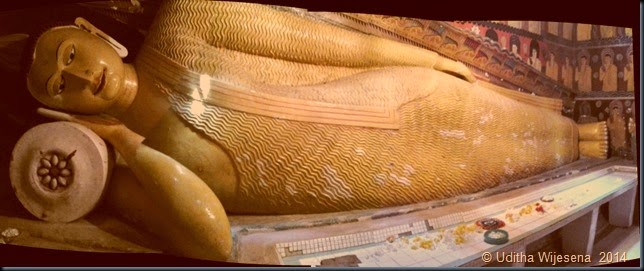
The two main entrances to the inner chamber have the British insignia painted above and are set within the traditional makara-thorana. The main attraction inside the image house is a beautiful reclining Buddha showing links to Kandian sculpture and is larger in dimension to the standing image looking across a seated image that are positioned on the sidewalls. The general practice of locating the two chief disciples besides the Buddha has been avoided here. 

Gardian Sanda kinduru


A guardian image and images of Kinnara & Kinnari. Depicting the Sanda kinduru jataka


Reclining Buddha
The beautiful reclining Buddha
       
20140514_115534
20140514_115447


       The standing Buddha and the Meditating Buddha face each other


The outer walls of the inner chamber is different to those seen elsewhere.  The three sides besides the one with the entrances has the 28 images [Atavisi] of the previous Buddha mounted in line and are enclosed within a large glazed polished timber cabinet spanning the length of the walls. This is a special feature not generally seen during the Kandian era. This could be an addition to the outer chamber that was incorporated later. Polished timber outfits were not common in the Kandian era then. The floor of the outer chamber is laid with terracotta paving showing its age with the immense foot traffic it had had to cope with. 


20140514_122447
The Atavisi Buddha images

20140514_122026
20140514_122534


20140514_122409
The doratupala rupa or the guards at the doorway  show British soldiers instead of the traditional guard stones. Sri Wickrama Rajasinghe the last King is drawn smaller than the soldier probably showing the hold the British had on the society.
 
The temple and the murals have survived a timeline of 128 year to date. However  its future wellbeing is very bleak and is of concern. As already seen… the doors have come off the hinges. Lighting of oil lamps and josticks within for fragrance will cause damage to the vegetable dyes and colours in the murals.  Ground salinity with dampness is affecting the lower most murals and have faded them off completely. The murals around the windows are fading and have begun to scale. Stray mongrels are seen taking shelter within the chambers to nobodies concern. The contribution of the village community towards the temple is but shocking. This was evident with the fewness of floral offering on the altar on this most venerated day for the Buddhist…the Vesak?


Panorama 1
A traditional pageantry showing an insignia of Briton and colonial parasol

20140514_115836
The lion flag in procession

Panorama 2
Story of Patachara
  
20140514_120124
Note the Buddhas abode being illuminated with Dutch period lamps
Panorama 3
Note the minute detailing of the paintings
20140514_115749
Vesantharsa Jataka
20140514_115907
Donating the Ele Etha [Albino Elephant]
20140514_115859
A better preserved painting of the Vesanthara Jataka . Note the monkey on the roof. A problem then as now
20140514_120219
The Victorian stagecoach  the mode of conveyance of the elite
20140514_120320
Bullock carts and the thirikkala the mode of conveyance of the peasantry.
20140514_120345
Note the glass bottle with the dented bottom and the household pets
20140514_120556
Note the wine served in stemmed glasses
20140514_120619
Women and children in Victorian gowns
20140514_120616
British social gatherings of revelry with drums and harps. Note the gent in tinted eyeglasses.
20140514_120800
Royalty shown in British attire. Note the background is filled will nature

20140514_121128
20140514_121120
Topless women shown wearing bibs to avoid obscenity
20140514_121149
Scene of hell the Satan wearing western attire 
20140514_121527
The coconut palm native to the area
clock
Note the clock with roman numerals
20140514_120632
The ceiling motif 
20140514_120231
Rivers are drawn flowing upwards in the Kandian style. Note the type of fish and the turtle native to the coastal habitat.


20140514_123325
20140514_123140


 Hemamala and Wilson with the author

On the way back we glimpsed into the Ranwella temple in Giniwella. This temple too has an octagonal image house with the outer walls done with murals to the same style but in recent times.  The doors and windows have Gothic features as those in the christian churches. 

Gothic windows
20140514_130156
The remains of the press after the fire
 
What is significant here is the old printing press donated by the King Chulalongkorn of Siam in 1860 [locally pronounced Chulalankara] on the request of Ven. Bulathgama Dhammalankara Siri Sumanatissa Thera, the chief incumbent at the Paramananda temple in Minuwangoda, Galle; who felt the need of a Sinhala newspaper then


The first Sri Lankan newspaper being ‘Lakmini Pahana’ printed in 1862  was in fact after the ‘Lanka Lokaya’ that was published two years before on this machine,  but it  was not registered as a newspaper.


It is said the press was of immense service during the Panadura wadaya when all of the information about it was printed on this press.  


The press was closely guarded by the monks at the Ranwella temple for nearly 140 years, until a fire destroyed the monastery building in November 2012 bring in destruction to the artifact. The metal  braved the blaze but for the timber components, the letter-sets and other.