Wednesday, May 27, 2020

Leonard Woolf’s “Village in the Jungle” in Hambantota is hard to find today.


Leonard Sidney Woolf (Barrister and Queen's Counsel) moved to then Ceylon; Sri Lanka today in October 1904 to join the Ceylon Civil Service [CCS] as a cadet. After a brief period in Colombo, he is posted to Jaffna in January 1905. Two years and seven months in Jaffna, Woolf is transferred to Kandy as an apprentice to the Ceylon Civil Service, on a salary of £ 200 a year. A year in Kandy with three and a half years of cadetship in the CCS, he is promoted to assume duties as Assistant Government Agent in the Hambantota District in August 1908. From then until May 1911, he worked in Hambantota for 2 years and 9 months.

Woolf returns to England on vacation in May 1911, after serving in the civil service in Sri Lanka for nearly six and a half years. While in England he meets Virginia Stephen and they fall in love. The intended marriage took time and his leave coming to an end Woolf applies for an additional three months quoting it to be a private matter. On his refusal to divulge the nature of his private business he is not granted an extension and he in turn sends in his resignation and marries Miss Adeline Virginia Stephen in 1912. She became one of the brightest stars in English literature, entitled Virginia Woolf. After marriage, Woolf turned to write and published his first novel, The Village in the Jungle (1913), which is based on his years in Ceylon [Hambantota]. The source of Sinhalese life in the early 19th century is chronicled in the book as noted and recorded by the author. By now he became a bitter enemy of the Colonial Service turning out to be a Fabian and a Socialist in his own country.

Woolf is remembered in Sri Lanka for the excellent record keeping during his time in the CCS. “Diaries in Ceylon, 1908-1911” the official diaries maintained by Leonard Woolf; Assistant Government Agent of the Hambantota District, Ceylon, during the period August 1908 to May 1911 are now compiled and published, and is today a proven reference for scholars 
.
However, in Sri Lanka it is the translation of Village in the Jungle by A P Gunaratne into Sinhala as Beddegama (1949) [should not be mispresented as Baddegama a town in the Gale district] that became popular which made Leonard Woolf a household name in Sri Lanka. The harshness of the jungle life became closer to the Sinhala reader with the naturalism of the novel through the smooth and friendly vocabulary practiced by Mr. Gunaratne. The simple, direct, and elegant style of writing used by him is an excellent means of stimulating the real taste of the original story. Accordingly 'Beddegama' is thought to be independent of Leonard Woolf's book The Village in the Jungle by the literary luminary in this country. Thus Beddegama by A P Gunaratne was recommended a middle school reader in Sri Lanka schools.

It is also interesting to note that Woolf in his autobiography notes that over a period of fifteen years the first edition of the book brought him only 38 pounds and that it was a total failure as a novel in England. This was not the case with A P Gunaratne’s Beddegama and the reason for its failure in England is shown as there are no Western characters in it to be attractive to the English society. For this reason nobody talks of Village in the Jungle as a great English classic unlike A J Foster’s ‘A Passage to India’ both being set in the Colonial East.

Beddegama a cinema

Lester James Peiris [LJP] the father of Sri Lankan outdoor cinema personally picked the Village in the Jungle to be turned into a cinema and it was only after Woolf’s demise that he was able to get the film rights from the agency that took up Woolfe’s publishing. The story of Beddegama being very popular in Sri Lanka and a commercial film on it was thought to be an investment.

Beddegama consisted of just ten houses. The houses which are made of clay are more like poor shanties. Only the village headman had a proper roofed house in the whole village. Almost all the other houses were coconut thatched. The lake was situated on the east side of the houses. They sowed paddy fields below the village tank, and when asked about their occupation, they were told, "Paddy farming is the norm." They were all members of the Govi-gama clan and lived through chena [slash and burn] cultivation. Grains such as kurakkan, millet, and vegetables such as chili, cucumber, and pumpkin was grown in them. This grain from these chenas was thought not to be good for them. Some people suffered from Lassa fever [parangi] with the heat around affected their blood; it was thought to make them sick. It was difficult to find a villager who was not with infected wounds attracting flies and deep in the flesh exposing bone.

Little children who were born were also malnourished. Those who were lazy to cultivate chenas used to hunt the animals in the forest. It was the forest itself that encroached the village turning them into animals in the forest. The author symbolizes the tragedy that befell the village and its people through the character Selindu who also perishes with a double murder committed by him. The village Headman or Archchirala is Babehamy. One of his sisters, Dingyhamy, is Selindu's wife, who is beaten by Selindu for having delivered twins and she dies two days after the twin childbirth.

From then on, Selindu and Arachchirala are alienated. Babehamy cancels Sindhu's chena license in revenge. This indicates the existence of aristocracy in remote and underdeveloped Hambantota even then. Beddegama exemplifies how the aristocrats worked to crush the poor farmers and make their lives miserable. But they seem not to know it.

Arachchirala's brother Babbun, makes Punchi Menika, one of Selindu's daughters as his wife. Babehami and Nanchohamy opposes this marriage. Fernando Mudalali, who came to collect the loans given to the villagers, gets help from Arachchirala as he wants to have a casual association with the Punchi Menika. Babun opposes this approach and as a result, he is sent to jail for six months on false charges that he had stolen items from Arachchirala's house. Selindu is shocked by this outcome. Arachchirala and Fernando Mudalal are shot dead. Selindu is sentenced to 20 years in prison. Punchi Menika is now alone in Beddegama.


LJP on completion of this cinema Beddegema was at the receiving end of a host of local critics. Some even went to the extent of calling him to have castrated the novel Beddegama. LJP had a preference for selecting his cast from a selected group of local actors. Malini Fonseka and Vijaya Kumaratunga characterizing Babun and Punci Menika with their beautiful bodies did not match the inhabitants of Beddegama. Their hairstyles and picked eyebrows were too significant. The houses built were more new than described in the book. The front yard of the houses were picked and clean. The oil lamps were of modern-day type. But LJP defended the critics with his cinematography to those details in the novel.

However, as always LJP extends his cinema to the Western media and Beddegama was purchased by Janus, a big German Company and was screened at the Cannes Film Festival in 1980.

Locating the Village in the Jungle

Ever since the screening of the film Beddegama there was a curiosity to visit this village by the increasing new rich of the middle class that took to traveling the countryside in the late 80’s and the 90’s.

Hambantota district extends from Nakulugamuwa to the West and Yala border in the East. The area either sides of the Malala Oya basing was not that harsh as described in the book with the promising irrigation schemes that Woolf himself managed which were rehabilitated by the Colonial British. Therefore the said arid and difficult lands that Woolf regularly visited as per his diaries should be the arid and dry Malala Oya basin that is just to the North of the Hambantota town which housed Woolf’s headquarters or the Kachcheri the district administration unit. As the name implies (Mala)-la is dead in native Sinhala while the adjoining basin to the west is named (Mau) Ara, meaning the maternal seemingly dependable water source. The Malala Oya basin was also considered for restoration by the British to a limited extent. The uppermost village Mahagal Wewa and the lowermost village the Badagiriya Wewa were restored. Mahagal Wewa has its catchment in the intermediate climate zone with a favorable rainfall did fill up during the monsoon and Badagiriya Wewa did catchup all the drainage from Mahagal Wewa and the not so promising monsoon rain. Woolf has numerous entries related to a location by the name Meegahajandura in the upper reaches of the Malala Oya, just below Mahagal Wewa.  Thereby many are of the opinion that the Village in the Jungle that Woolf described is Meegahajandura.

Christopher Ondaatje the elder sibling of Michael Ondaatje a world travel adventurist and researcher has researched Woolf and produced a detailed volume on him; ‘Woolf in Ceylon’. He traveled the path that Woolf took in the turn of the 20thcentury and does an in-depth study on the novel and his diaries and finds a combination of an isolated incident that took place in Hambantota which is recorded in his diaries under the date 13th December 1910…….

‘During my absence on circuit there has been a most cold-blooded murder at Malasnegalwewa which Mr. Willett came down especially to inquire into as police magistrate…. In this case the vel-vidane deliberately shot the acting vidane arachchi from behind and then walked a mile to shoot the ex-vidane arachchi, the acting V.A’s father. He found the old man digging in his garden and shot him dead. He then went to the mudaliyar and gave himself up’.

Christopher Ondaatje has followed this entry on the ground and visited Malasnagalwewa and located a family who has documentation related to Woolf compensating land to a Siriwardane family possibly for acting for the responsibilities of the Vidane Arachchci until the appointment of a new Vidane Arachchi was made.

Therefore it could be said that there is no such particular village that Woolf highlights in his novel but that of the miserable lifestyle that peasantry in the whole of Malala Oya Basin experienced and how their own aristocracy exploited them. He has adopted the character Selindu to the incident at Malasnagalwewa which is also located lower down in the Malala Oya basin to signify the plot in the novel.


Woolf’s Return Visit to Ceylon - February 1960

Woolf did a second visit to Ceylon in 1960 at age 79. He traverses the same route to Jaffna, Kandy and Hambantota. In Hambantota he comments to that the courthouse which had not changed a bit. The environs to the immediate of Hambantota and the surround to his Jungle Village is still the same. This is almost 50 years ago and the poverty, the hardship, and the misery of life he saw then are still the same. He did have a bitter feeling when a person by the name of E R Wijesinghe then in his 80’s approached him at the Galle Face Hotel; Wijesinghe was then a mudaliar and later a Local Government Officer in Hambantota and questioned him of reprimanding him during his tenure as the Assistant Government Agent on an incident related to the shooting of a buffalo contacted with rinderpest. This issue did continue in the print media even after Woolf ended his three-week tour of Ceylon. Woolf had to respond in replying from England to which he said it was correct then for that was the law and he had to abide in it. Woolf was a very strict administrator.

Hambantota after 1977.

Much did change after 1977 with the new political administration that was established liberalizing the economy and the undertaking of foreign investment for large-scale development. Hambantota was earmarked to be a backward district needing much economic development.  NORAD, the Norwegian Agency for Development Corporation a state agency under the Norwegian Ministry of Foreign Affairs took up the uplifting related to economic development in the Hambantota district with a grant for development over a 10 year timeline. It was a multi-faceted approach for agriculture, education, irrigation, culture, cottage industry, roads, forestry, etc.

Much of this development took place in the dry parched Malala Oya basin. The significance being the total rehabilitation of the village irrigation tank system in the several cascading clusters in the Malala Oya basin. This was accomplished in a five-year program but the rehabilitated infrastructure now faced a greater problem of there being no water in the catchment to hold back in these restored tanks for irrigation.

The Malala Oya Basin and location of the trans-basin canal.
The Malala Oya Basin is a highly water-short basin where the mean annual rainfall is around 1000 mm while the mean annual evaporation is around 1550 mm. This figures itself are self-explanatory of the scorching heat in the area. Of a total of 371 small tanks within the basin, only 29 tanks are currently functioning. And that too only during a single wet monsoon season called the Maha crop of paddy. That too in a good rainy season. This gives the measure of the hydrological stress that is present within this basin.

It was this factor that we in the Irritation Department of the Hambantota Irrigation office had to solve in order to augment these renovated tanks. I was also a member of a team headed by the then Engineer Mr. Paranammne to investigate and suggest a solution for the scarcity of water in the Malala Oya basin.

The Mau Ara to the West of the Malala Oya basin was untapped even for the Uda-Walawe Scheme as it fed the Walawe River in the form of seasonal flash floods. It was therefore an unreliable water source in the Uda Walawe design. Our investigations showed that damming this and feeding the Malala Oya basin was a possibility. This new dam which will be located within the Udawalawe National Park was proposed as a water source for the wildlife in the Park and a trans-basin canal would take the water to the Malala Oya basin. 

The Irrigation Department initially was not in favor of the project given the many stakeholders to deal with. NORAD though in favor of the project was not willing to finance it both for its colossus amount already expended in the rehabilitation of tanks in the basin and its development plan being in the finishing stage. The unstable political situation in the country in the late ’80s did not have priorities for such projects. We then approached the Director ARTI to organize an awareness seminar to the numerous stakeholders that needed to be coordinated for such a project. Even after such an awareness programme, the project was to be shelved. 

Traverse pathway of the trans-basin feeder canal 

It was only after a new government which came to power in 1994 that the then Minister for Irrigation and Agriculture being an elected  member from the Hambantota district that the project became a reality and a trans-basin canal 34 kilometers in length from the Mau Ara Reservoir built across the Mau Ara augmented the Malala Oya basin. The Village in the Jungle that Woolf saw is no more. On the 2nd day in November 2002 with water from Mau Ara coming all the way to Palle Mattala Tank feeding many of the cascading clusters that were once parched of water is today a mat of green paddies.


A few years later came the Mattala Airport which is just below the Palle Mattala Tank, which is also the endpoint of the trans-basin canal and in close proximity to the Malasnagala Wewa where the double murder during Woolf’s time tool place. There is today an International Cricket Stadium just below the Meegahajandura Tank. Lately the Southern Expressway cut across the Malala Oya basin linking the Hambantota Airport with the Colombo Metropolis.

It’s almost 100 years since Woolf sentenced the accused for the double murder at Malasnagal Wewa and his Village in the Jungle is a totally different habitat today. But travel-hungry people still come looking for the Tamarind tree under which Woolf and Mr. Willett conducted the inquiry into the double murder on a day in December 1910.


References:
Ondaatje Christopher - Woolf in Ceylon
De Silva Kumar – Lester by Lester as told to Kumar de silva.
Gunaratne A P - Baddegama
Panabokke C R et.al -  Characterization and Monitoring of the Regolith Aquifer within Four Selected                                       Cascades (Sub-watersheds) of the Malala Oya Basin

Sunday, April 12, 2020

A Trip to the GA’s Bungalow Polonnaruwa ?


This is a true story that took place way back in the year 1981. We were newly married with our baby son Naveen just a few months after his first birthday. Employed as a technocrat in the Irrigation Department took me into remote wilderness locations on duty. My narration of these wild locations enthused the in-laws that we make a trip to the North Central Province (NCP) and back. Living in Galle it would be a long way out to the NCP.

The dates for the trip was on a long weekend in October and the itinerary was drawn up assisted by my bosom pal Wilson Kulasuriya.  The trip for three-night outs were approved by all. The first day was basically a run-up to Chenkalady for the night a township in the Eastern Province with a visit to Buduruwagala, a place close to Wellawaya, that had effigies carved out of living rock. Day two to Polonnaruwa with a stay over in Polonnaruwa. Subsequently, proceed to Anuradhapura for an overnight stay and back to Galle the following day. The itinerary was passed by all. However, the long haul from Galle to Chenkalady was something that did have my fingers crossed.  This was in the year 1981 and the roads were of a rickety, bumpy state.


Next was to find a mode of conveyance. An enterprising Storekeeper in my office who had invested in a passenger bus service then, helped me locate a sixteen seater TOYOTA van. The dates fixed and the estimate for three days was thought to be fair. Our salaries then were very meager and limited to three digits.  However, the trip cost ran to four digits and we had to look for additional trippers to meet the budget. Finally, the budget was met exceeding the seating capacity. The kids and babies will have a lap ride all the way. The three-night stays were arranged with request Postcards sent out to the locations for reservation. The night in Chenkalady will be in the Irrigation Camp. Polonnaruwa was to be in a pilgrim rest in the vicinity of the Government Agents residence and the Dutugemunu Pilgrims rest was to be the night stay in Anuradhapura. The Postal Service then was thought to be reliable but for its promptness in deliveries.

Finally, the planned day dawned and the trip did kickoff on time at 4:00 A.M as scheduled from Galle. Breakfast was planned at Ambalantota at a relative’s house where three more trippers would hop in. A general timing of an hour for breakfast in Ambalantota did overrun with all the fun and laughter, longtime no sees, loo queues, plain tea, and milk tea mix-ups and finally we are back on the road to Buduruwagala.

We locate the turnoff to Buduruwagala with much difficulty and are on a dirt track which is in a very bad state for an overcrowded vehicle. No Google Maps or Air-conditioning then, we are drenched in sweat in a humid forest area covered in tall grasses. The van comes to an abrupt halt and the driver says … it’s the end of the road. On inquiries from some workmen living in temporary coconut cajan huts, we are told that the Buduruwagala Tank Bund had breached during the previous monsoon and the escaped waters had totally scoured the road below and the only way to the rock with its beautiful carved effigies was by the contractor’s boat service that took visitors across the tank for a fee. We are told that a party had already gone in the boat and once they are back another party is ready to go and our turn will be once they are back. Rough calculation showed a lapse of over four hours and we decide to abandon the visit to the effigy rock and decide to proceed. We still have more than half the distance for the day to be covered.  We had packed lunch on the way and did dose off when the driver missed a turn and we are now traversing via Passara/Lunugala a detour accounting for extra time and adding insult to injury we have a punctured tire. The wheel changed we are carrying the punctured tire to be vulcanized and repaired in Chenkalady. Passing Mahiyangane we reach Maha-Oya when darkness falls and is stopped at a police road barrier. There had been some skirmish with the security forces and the Tamil militia in Chenkalady and a Police curfew has been imposed for two days. The civil unrest that later turned into a thirty-year war was just in its brewing stage in 1981.

I’m now in a dilemma …. Is it the end of the trip? However, the priority now was to find a place for the night as darkness was closing up in all directions. The Maha-Oya Buddhist Temple was our only solace and some of us approached the chief prelate and explained our plight. His stand was that he would not allow his premises other than for pilgrims and as we were on our way to Polonnaruwa which according to his standards was not a pilgrimage, and was not happy in accommodating us. However, seeing the women and children and the menfolk to be of sober habits the temple gates were opened. A quick meal prepared and arrangements were made for the night in the sermon hall. The women were given the luxury of the limited water resource in the temple and the males went to the hot springs for a bath and to clean and wash the van. It was to be a very dark night.


Back after dinner, we have a major problem to be sorted for day two. We will have to either abandon the trip and go back home or travel all the way to Anuradhapura and Polonnaruwa via Kandy through the Hasalaka - Hunnasgiriya road on the sixteen hairpin bends. The extra cost and time is no way a match for us. However, enthusiasm and adventurism of the team said otherwise. There is a jeep track from a turn off midway between Maha-Oya and Mahiyangane through Weddah country to Welikanda on the Polonnaruwa - Batticaloa road. Welikanda is outside the Batticaloa district and is curfew free. Drivers agree and democracy had its way that day. We would leave as early as possible before sunrise and we are on the jeep track around seven in the morning.

(Apparently, this is the road that runs from Welikanda to Mahiyangane today via Girandurukotte and Siripura)

Breakfast was had on the way with plain tea from a wayside kiosk that served a smoke flavored black brew… my instincts say if we are lucky on this jungle tract we should be in Welikanda by around 2:30/3:00 P.M. But around 10 O’clock the sun is a scorching silver ball and we are sweltering in a crammed van running at breakneck speed in an elephant infested habitat in the dry zone jungles. The dust cloud created by the van is racing behind us, and it overtakes each time the van negotiated a ditch or a scour on the dirt track. Our exposed skin and hair turned brown with the dust cloud giving us all an aboriginal look. Everybody is silent through fear of possible elephant encounters or a possible breakdown that would strand us in this no man’s land.  The body language, however, did discomfit me as the trip coordinator and the feeling and expression of contempt that would fall on me, if at all we get stranded in this jungle. Just then we are struck with a disaster once again. We have another tire puncture and the feeling of being stranded is almost inevitable now with no spare wheel to change as we had not got the puncture repaired yesterday. We are stranded for sure and I’m looked at by everyone but I don’t give a damn but help the drivers with the wheel and looking for large stones to prop up the vehicle. The drivers will now have to carry the two tries to a local vulcanizing shed to mend them and come back. Our only hope now is for a bicycle or a farmer’s tractor coming this way. An hour passes and our people are in various locations where there is a shade. The kids are irritated and the mothers have a time comforting them. Our straining eyes see a speck in the distance and when it nears its a two-wheeled tractor with trailer. We are in a locality called Pimureththewa; there is an Irrigation Department workshop close by where we will have assistance. Two hours have gone and we are still stranded… but have trekked through curiosity to the upper reaches of the Pibureththewa tank and the kids are in the water and somewhat a comforting feeling to all in this scorching heat. By the time the van is ready the sun has turned over to the setting side. We have lost day two as well on the outskirts of the Pibureththewa jungles and I have another issue that’s worrying me now.  

Our overnight stay in Polonnaruwa is not confirmed and my plan was to finalize matters when in Polonnaruwa as the travel from Chenkalady to Polonnaruwa was only three hours then and a contingency could be sorted out if we were not booked in. However, now we are reaching Polonnaruwa once again in the late evening and locating a place as a contingency plan would be very vague. I had sent a Postcard in time to the pilgrims' rest but if it was received on time at the rest was my issue.  The rest is located close to the Government Agents residence and therefore I had addressed the postcard thus….The Pilgrims Rest, Near GA’s Bungalow, Polonnaruwa.” 

We are now in Welikanda on the Polonnaruwa-Batticaloa highway and with a short time, we would be in Polonnaruwa and darkness would be falling soon. Where are we heading to? ask a voice from the front and I say ‘ask for the GA’s bungalow’.  ‘Are we staying there tonight?’ was the sarcasm in the question and the joke was enjoyed by everyone except me. We are there at the supposed pilgrim’s rest which is now full of activity with people running about chatting, cooking, washing, bathing, etc. We walk up to the caretaker/manager and explain our situation and ask to be excused for being late arrivals.

A humble gentleman looks up at us from his desk and asks in the native Sinhala tongue…                 à¶”à¶¶ à¶­ුමන්à¶½ දිà·ƒාà¶´à¶­ි à·„ාමුදුà¶»ුවන්à¶œෙ à¶±ෑදෑයොද?” ….. (Are you the people related to the Government Agent)…others looked at each other.... my wit came in in no time knowing what would have happed …. I said ඔව් ඔව් à¶’ à¶…à¶´ි තමයි”… (Yes, yes… they are us).

The postman had delivered the Postcard to the GA’s bungalow instead and the GA on his way to the Kachcheri had handed the Postcard to the caretaker/manager and explained that a party would arrive on the said date.  

There had been many callers that day for accommodation but the large room had been kept reserved for GA’s relatives. My day was saved and right through the period at the  Polonnaruwa rest we were all relations of the Government Agent Polonnaruwa.

The trip now had to have an extra day as all needed to look around Polonnaruwa. And we being relatives of the GA the humble caretaker/manager allowed us an extra day in his rest. The trip continued a day behind schedule to Anuradhapura and we had no issues during the rest of the trip.  

Wednesday, April 17, 2019

CATTLE EGRET - MIGRANT OR RESIDENT?


Bird watching in the 21th century took a different turn with many taking to digital bird photography. The old school birder who preferred to identify birds in the conventional way is now bypassed with photo identification. The advantage of having a picture for future reference is very much convenient to a hastily done field sketch. Bird photography today has advocated the need to review and revisit some bird behavior that show unusually high populations during a certain time of the year. Research studies on these aspects have now been undertaken on some commonly occurring bird species by local universities to determine their home ranges and migratory status. The Cattle Egret and the Indian Pond Heron are two such bird species under review.

 Both these species show off nuptial plumage changes of a breeding season with significant color change but no firm nest building behavior is recorded in any known heronry where much photography has emerged. Although it is adjudged a disapprobation to photograph nesting birds and their breeding behavior, the unscrupulous photographer still pursue his habit. There is literature on the breeding behavior and timelines with clutch sizes in old records of G M Henry and others ornithologists of the past but with no firm recordings at present time.

Cattle Egret

The Cattle Egret is of two subspecies. The Eastern Cattle Egret [Bubulcus coromandus] and the Western Cattle Egret [Bubulcus ibis]. The Eastern Cattle Egret; a species of heron is found in the tropics and subtropical warm temperate zones and the Western Cattle Egret is classified as those found outside these areas. Despite the similarities in plumage which is closer to the egrets of the genus Egretta,… they are more closely related to the herons of Ardea.


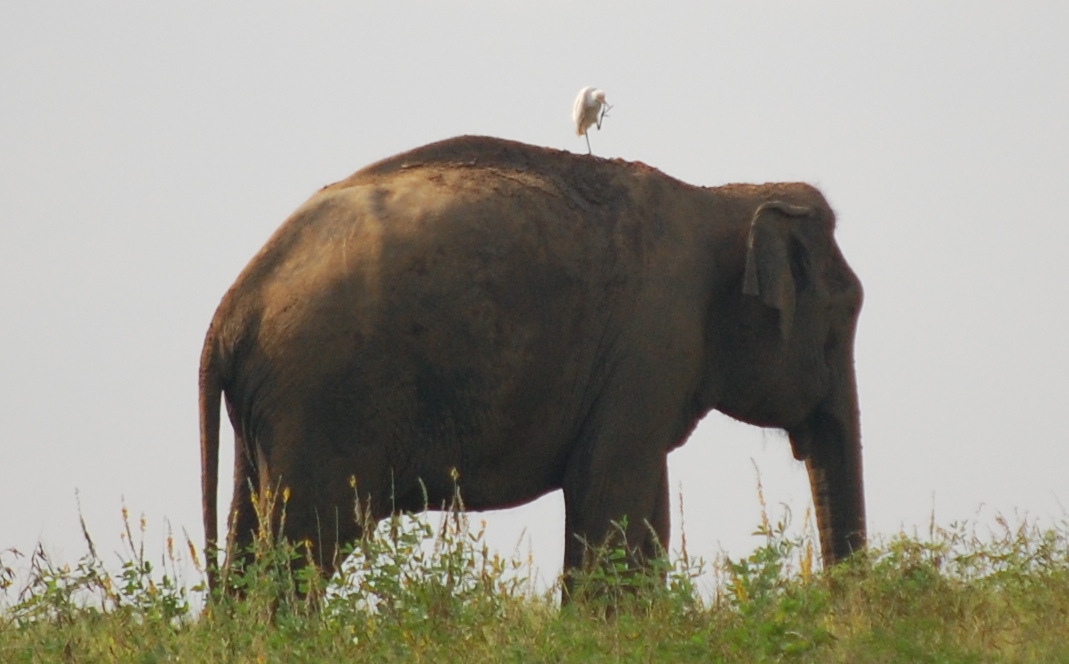
It is named for its habit in associating with grazing livestock to feed on the invertebrate prey disturbed by the hooves of moving cattle. But today with the shifting of grassland faming to closed house farming systems and overgrazing of grassland we don’t see them associating cattle very much. The cattle egret has a unique adaptation for catching its moving prey in flight …. Unlike most birds adapting to have its head stationary with their eyes focused on its prey, the Cattle Egret moves its head to either side in quick succession before it lunges forward in a stabbing gusto to grab the flying bug. At times it would hitch a ride on the animal’s back picking the ticks and fleas off its hide. There are times when it prefers to relax on the largest terrestrial beast when tired of following it.  


Galoya - Pic Uditha Wijesena

As mentioned above with the foraging livestock moving out and the tall grasses diminishing from overgrazing the Egret is now frequenting the ever increasing urban garbage dumps and landfills for grubs and bugs. Our Sri Lankan domestic garbage being wet and biodegradable is an ideal medium for breeding House Fly [Musca domestica] and the Bluebottle Fly [Protophormia terraenovae.] Both the flies are considered pest and disease transmitting vectors and the Cattle Egret is most welcome on these sites for vector control.
Kurunegala in July 2018 - No Cattle Egrets seen on Garbage

Urban garbage today is a national crisis and the biodegradable component of it is managed by turning it to compost through various programmes. The latest being a Japanese Technology introduced with comprehensive mechanical means to handle over 50 tons of garbage per day. The author is currently in this project on seven sites scattered in the country and is familiar associating the nauseating stench and the hordes of teeming flies swarming all over you in a humid locality. It’s so tricky to avoid them from getting into your garments. And when in the vehicle, its a task that would go on for 20 kilometers or more to rid the last fly out of the car.

This was normal on our site visits until during one visit it was significantly noticed that the flies had all gone. On close inspection it was seen that the flies had now been replaced by thousands of pure white plumage of Cattle Egrets that looked more like white sheets covering the dumps.

Dambulla grubbing alongside Elephants

Ampara - Deegawapi

The reason for the fly less atmosphere was the presence of the Cattle Egrets that feasted on them assisted with  Barn Swallows that crisscrossed the dumps regularly and rest on the roof trusses of the many sheds in these yards.

Barn Swallow - Kurunegala
The presence to the Ban Swallow prompted the beginning of the bird migration period for it being a regular winter visitor to the country……. But then the Cattle Egret? In such heavy numbers to have visited with the Barn Swallow suggests them also to be a group that migrated into the country? This notion had some confirmation with the bird being in all the seven locations in seven provinces at the same time in such large numbers.


Kurunegala February 2019 - Cattle Egrets grubbing inside yards
They initially feasted on the fly population and later picked on the maggots and the fly larvae, ridding the menace of irritation and the health hazard. They are still in the country but will soon be gone if they are migrants. I will keep watch for the increase in the fly population with the Cattle Egret gone in these sites. Their suspected migration was not significant until the number of people getting interested in birds and bird photography increased in the country I feel.

Pollonaruwa


Hambantota


There is scientific research to identify some populations of cattle egrets to be migratory and described as below;
"In many areas populations can be both sedentary and migratory. In the northern hemisphere, migration is from cooler climes to warmer areas. But Cattle Egrets breeding in Australia migrate to cooler Tasmania and New Zealand in the winter and return in the spring. Populations in southern India appear to show local migrations in response to the monsoons. They move north from Kerala after September. During winter, many birds have been seen flying at night with flocks of Indian Pond Herons [Ardeola grayii] on the South-Eastern coast of India, and a winter influx has also been noted in Sri Lanka."

As we have already commenced studies on the Cattle Egret it is high time that a comprehensive study be undertaken on the Indian Pond Heron as well, which also flaunt nuptial plumage sans any breeding noted recently…..there were some unusual flight patterns in large numbers of Indian Pond Herons along the sea coast flying in a Northerly path in and around the Colombo metropolis, observed sometime back.  

Saturday, March 9, 2019

Did the Greater Flamingo Leave Bundala Due to Change in Ecology or Otherwise?

Greater Flamingo in Bundala Year 1986                                                        Uditha Wijesena
Sri Lanka is unique in its geographic positioning with regard to World Bird Migration. Breeding birds in the Northern hemisphere migrate to the equatorial regions in the wintery season and back to their breeding grounds in spring and summer. Ornithologist and biologists the world over have studied these bird migratory patterns and developed a set of regular routes called flyways.  Almost always these flyways end up with a landmass beyond which is the southern sea that extended all the way to the South Pole.

Sri Lanka therefore is the last landmass in the Central Asian Flyway. Thus the arid zone in the extreme southern district of Hambantota with the Bundala Wetlands and the  dry zone shrub jungle habitat of the Yala National Park has been a heaven and the last staging post for the migratory birds in the Central Asian Flyway. The concentration of waterfowl in the Bundala wetlands which comprise of three large brackish water-bodies the Bundala, Embilakala and the Malala lagoons were declared a Wetland of International Importance (RAMSAR Site) on 15th June 1990, and it was the first such to be declared in Sri Lanka and Bundala was the 487 th site in the world. Today Sri Lanka has 6 sites declared as Internationally Important Wetlands listed under RAMSAR.


World Migratory Bird Flyways


The description of Bundala under Sri Lanka and its importance in the listing is cited as follows:

“Southern Province; 6,210 ha; 06°10'N 081°12'E. Flora and Fauna Sanctuary. Four shallow, brackish lagoons and saltpans interconnected by channels with associated marshes, dunes and scrub. It is the most important wintering site in southern Sri Lanka for migratory shorebirds, regularly holding over 15,000 individuals of various species, and provides habitat for rare and threatened water bird species. Human activities include commercial salt extraction, subsistence fishing, wildlife tourism, livestock grazing, and firewood collection. Ramsar site no. 487. Most recent RIS information: 1990.”

Bundala a Protected Area
Bundala records to a very ancient village in the Hambantota District and the famous Assist Government Agent Leonard Woolf’s administrative reports and diaries refer to the fauna and flora and the struggle for existence of its people in a very dry harsh climate. Bundala and its vicinity among the four lagoons however was declared a wildlife sanctuary in December 1969 and remained thus until the area was upgraded to a National Park in January 1993. This brought a stop to all human activity in an area of 2600 hectares requiring relocation of some parts of the ancient village. Later in 2004 it was regazetted with a reduced land area of 3700 hectares and today Bundala is the recipient of numerous other declarations. A “Man and Biosphere Reserve by the UNESCO in 2005 and “Bundala-Wilmanna Sanctuary” in January 2006 identifying a buffer zone of a further 3696 hectares of land adjacent to the National Park.

Though Bundala today is recognized internationally as a final staging post for migratory waterfowl; the actual story of Bundala is but alarming and tragic. If one is to reconsider why Bundala required recognition and protection it could be said without any doubt it was its pristine saline habitat and the wondrous number of waterfowl that frequented the location annually. If it was to be the current condition then Bundala would take time to qualify to a RAMSAR status.

However Bundala was only a sanctuary where the people coexisted with the fauna and flora blending with the sustenance cultivation of paddies in the limited freshwater and with a controlled slash and burn cultivation in the short rainy season from November to January. It was so when it was declared a RAMSAR site in 1990. No human elephant conflicts heard as today and there was never a case where the waterfowl was exploited or disturbed by the villages.

Much earlier to this period it was the occasional trigger happy privileged sportsman who did visit Bundala with a licensed fire arm and a permit from the Government Agent Hambantota to shoot ducks. This habit too ended with the Amendment to the Flora & Fauna Act in 1964. Outside the sportsman it was the genuine nature lover and birdwatcher that did come all the way from Colombo to record the waterfowl and the magnificent Greater Flamingo migration to Bundala. There was hardly a lodging available in the area except for the Government Rest House in Hambantota or Thissamaharama.

Commercialized safaris did take place in a very small way from the early 1970’s with a few jeeps less than 10 in number that operated from Thissamaharama for the foreign tourist who came to visit the Yala National Park. They were then offered a bonus to see the Greater Flamingo in Bundala for an extra paltry sum the jeep driver charged for an extended drive to Bundala via Krinda without any entry fee. These jeep even then were marked as “Flamingo Safari”.

It should be noted that these jeep tours started in Thissamaharama was a substitution to an enterprising personality the famous ‘Tennis Ace’ D. D. N Sevadorai who brought his European and Scandinavian clientele on camping tours to Thissamaharama / Yala in jeeps with all the paraphernalia; tents, cutlery, crockery and even the spotless white table linen all the way from Colombo in the late 60’s and early 70’s. It is ironical to say that it was these humble beginnings of jeep tours that has turned in to a jeep mafia run by the local political goons today. 

National Parks in Sri Lanka   
It is not wrong to say the most Wildlife National Parks in the country have come up not with the sheer interest for wildlife protection or habitat protection but with the greed for the revenue from the entry fees. There was only two National parks the Yala and Wilpattu declared in 1938 until Galoya was declared in 1954. Large scale Development Projects like the Galoya and the Mahavelli Multipurpose Development Schemes did require protected areas for the displaced fauna when large jungle tracts were opened up for settlement.  The 1970’s saw two more National Parks the Yala East and the Udawalawe being declared. The accelerated Mahavelli scheme carved out four National Parks in Maduru Oya, Wasgamuwa, and the Mahavelli Floodplains in Somawathiya. Them being mainly to hold the displaced Elephant population.

Today there are 26 National parks with 15 of them named after Bundala was declared in 1993. It could be clearly said that Bundala, Minneriya and Kaudulla were localities where the tourism trade blossomed and the local hotels in Habarana and Thissamaharama arranged localized jeep safaris to see wild elephants and birds. This triggered off the Department of Wildlife Conservation [DWLC] to fence up ticketing booths and gazette a boundary demarcating a National Park. National Parks are said to be the largest revenue collectors outside the Department of Customs in this country. As recorded by the DWLC the Yala National Park itself has generated Rs. 612 Million as revenue during the period from January 2018 to October 2018.   However it should be noted that these monies all end up in the Government Consolidated Fund and only a meager portion is utilized on the welfare of the fauna and its protection.


Bundala is affected by the KOIS Project
The upgrading of Bundala to a National Park in 1993 could be viewed only as a significance to it being declared a RAMSAR site in 1990 or as said before the revenue from entry permits from an already established localized wildlife tour operation. It is noted that most RAMSAR sites the world over are not strict reserves but where human activity coexist with a faunal presence. That was basically how Bundala became a RAMSAR site with its abundance of waterfowl until about 1989-90 when trouble started.

The then political ideology to open up large scale development projects primarily for political stability required a similar project as the Accelerated Mahavelli Scheme in the North Central Sri Lanka in the South as well. This was also highlight in a Commission Report on the 1971 youth unrest and the insurgency that originated in the South. The result being the Kirindi Oya Irrigation and Settlement Project [KOISP], or better known as the Lunugamwehera Reservoir project. The proposed KOISP Right Bank Canal [RBC] was to extend all the way to the Badagiriya Tank the then existent last paddy tract on the Malala Ara basin.   

The KOISP performed below expectations with the expected water yields not achieved and messing up cropping patterns. It is rumored of a mix up of flood records where isolated heavy flooded years being considered for yield calculations when they should have been left out as outliers. The Right Bank Canal [RBC] planned to feed the Badagiriya Tank had to stop short of the Badagiriya Tank and the Tracks 3 & 4 located just above the Bundala Lagoon be abandoned due to the water deficiency.

The feasibility report on the KOISP did say that the land was not the best suited for paddy but for other fiber crops. The political administration and the settlers were adamant to develop the land for paddy with the misconception that the already existent 5 tank irrigation scheme in the lower areas with alluvial soils did give favorable yields. Today people have started moving to highland crops as banana and gherkin instead. 

The drainage water from Tracks 1, 2, 5 & 6 were confined above the A2 road trace from Hambantota to Weerawila and are flowing into the Embilakala and the Malala Lagoons. The salinity in both these waterbodies dropped with the swelling water levels. The favored brackish water for the aquatic organism diminished bringing a total change in the ecology. This high water level in the Malala Lagoon was controlled to a certain aspect by providing a permanent opening into the sea through an outfall canal and groyne constructed into the sea.   

A performance audit report compiled in the year 2000 for the KOISP refers to the environment in a very short paragraph thus ….

The environmental record is mixed with some significant disbenefits, notably a reduction in salinity of the ecologically valuable coastal lagoons. However, the human environment within the command area is now aesthetically attractive compared to adjoining slash and burn agricultural areas, while malaria incidence is reported to have fallen significantly.”

Even though the effects of excessive drainage is seen only in the Embilakala and the Malala Lagoons it is strange to note an ecological effect on the Bundala Lagoon as well even though Bundala is located slightly higher in a different catchment. It would have been of the same fate had the tracks 3 & 4 being opened for paddies which would have drained directly into the Bundala Lagoon.


The mystery behind the Bundala Flamingo and change in Ecology    
Bundala had but a flagship species the Flamingo. Of all the issues that Bundala faces today from human activity within the park to the invasive flora of Prosopis Julifora, commonly known as ‘Kalapu Andara’ in and around the wetland it is the missing Greater Flamingo that is to be of significance to everyone.

Flamingos are all members of the Phoenicopteridae bird family and are six species; American (Caribbean) Flamingo (Phoenicopterus ruber), Andean Flamingo (Phoenicoparrus andinus), Chilean Flamingo (Phoenicopterus chilensis), Greater Flamingo (Phoenicopterus roseus), Lesser Flamingo (Phoeniconaias minor), Puna (James's) Flamingo (Phoenicoparrus jamesi). Of the six species Lesser Flamingo is the most numerous followed by the Greater Flamingo. The other four species are confined to the new world in the Americas. Sri Lanka is frequented by the Greater Flamingo a winter migrant from the Indian Rann of Kutch, a salt marsh in the Thar Desert in the Kutch District of Gujarat.

Pic Courtesy: https://birdeden.com/what-do-flamingos-eat
The greater flamingo is the largest flamingo species and can measure up to five feet tall when standing erect with its head raised, but only weighs a maximum of eight pounds. The lesser flamingo is the smallest flamingo reaching three feet and typically weighs 3-6 pounds. The flamingo's most characteristic habitats are large alkaline or saline lakes or estuarine lagoons that usually lack vegetation. These water bodies could be far inland or near the sea. All flamingos feed holding their bent bills upside down for several hours a day, filtering out food while skimming the water. They may seem to nibble or scoop at the surface of the water as they strain out small bits of algae, plant material, insects, brine shrimp, and other foods that make up their omnivorous diet.

Flamingos are said to be monogamous and lay only a single egg each year. If the egg fails to hatch or is predated they do not lay a replacement and can take several years to recover their population. However in the year 1997, a photograph published in a local newspaper of the Bundala flamingos’ nest-mounds did arouse interest among the bird enthusiasts. They never did lay and this development was thought to be an instinctive practice before returning to their customary breeding grounds.

It is noted that all this activity related to the Bundala flamingo came to an end in the mid-nineties.  There had been consecutive dry years where the lagoon was almost dry and ever since the drainage water came into the lagoons the alkaline ecology was affected.  In return the Asian Development Bank which was the funding agency for the KOISP did take up the task in analyzing and researching as to what went wrong in Bundala. But it was always with the focus of the quality of the discharge water and its biological acceptability as a discharge into surface waterbodies.

It is speculated that the Bundala lagoon has had no direct effect of the KOISP drainage discharge in to the lagoon as the tracts 3 & 4 are abandoned and therefore the reason for the missing Flamingo is not directly related to drainage discharges. There are other thoughts as well, when the saltern was made to stop letting brine water enter the lagoon which in return affected the artemia cysts growth the preferred food of the Greater Flamingo.

However as of present there has been no research done to ascertain the reason for the Flamingo to abandon Bundala and on a broader sense the whole of South and South/Eastern Sri Lanka. The Flamingo then was not confined to Bundala but did frequent all the southern salterns; the Maha lewaya in the Hambantota town and even the Karagan Lewaya which today has been converted into an inland harbor. They did frequent the Palatupane Lewaya in the immediate outskirts of the Yala National Park entrance.

However it should be noted that the flamingo is highly dependent on diet which is only found in abundance in highly alkaline concentrated water bodies and the change in the ecology does affect their survival drastically.

There had been similar incidents elsewhere.  The Lesser Flamingo is flying off, and fleeing a seemingly shrinking Lake Nakuru, the home that has sheltered them for uncounted centuries in the Lake Nakuru National Park in Kenya. The lake is drying and the receding shoreline result for many hundreds of dead flamingos littering the caked lakebed. The catchment area around Nakuru has been heavily deforested, and its rivers are running dry. Years of drought have further reduced the water supply. Global temperatures are rising and local sewer and industrial runoff from nearby Nakuru town is polluting the lake. This shallow lake and its shrinking flamingo population remains a complex question. The simplest answer is but its favoured food the blue-green algae has diminished within the lake and is no longer produced in that habitat ….again a change in the ecology.

Therefore we can draw similarities of Lake Nakuru with Bundala. The only difference being that the Lesser Flamingo of Lake Nakuru was a breeding resident while our Greater Flamingo is a migrant from the Rann of Kutch.  However they are quite in abundance in the Northern peninsular, the Mannar salterns and other alkaline lagoons and shallow seas around. But for the Greater Flamingo to abandon the South and the South/Eastern Sri Lanka is not really an issue related to the ecological change that Bundala underwent as a result of the KOISP.

So let’s be optimistic that they would come back someday once things are favorable for them or until the reasons for the loss of its favoured food source in the southern saltpans are found out through a comprehensive study.