Sunday, September 25, 2011

This Photograph is not Lying

Like so many seemingly impossible shots you see these days…. this shot is not a digital creation. That’s because I was not alone when it was taken at Great Western Talawakele. 

Photography today is a new turn altogether with digital technology overriding light exposed on celluloid. 

“No I did not just lift the camera and shoot this”……..but was following the bird on the adjoing tree and set the shutter on multiple exposure……… Of the series of shots that came through this was unique just before it landed vertically having stopped flying and is being carried through its momentum .

I must admit; I have filled some light into it as the subject was back-lit.


It’s the Brown-capped Pigmy Woodpecker; rather unusual for it to be in Talawakele.

Get the feeling that the distribution of many Bird Species needs to be reviewed very soon?

Monday, September 19, 2011

Globalization........

Seated at Heathrow’s transit lounge in Terminal 3 waiting for the display to light up the Gate Number for boarding my next connection, I think of  globalization and its contribution to the change of the world that we live in today.
Globalization; the process of building up connectivity and inter-dependencies of the markets of the world; that’s a very short way to say it….. and yes it sounds economic.
The trickle-down effect is, people are traveling about more frequently and in numbers. So was I; seated with my eyes scanning the thousands of people going by; eating, drinking, dozing on seats, some in conversation on mobiles, some with eyes glued to the display boards?
Seated for over an hour the board changed to say the gate number is to be displayed at 10.30 AM.
It's more waiting and more thinking…… The change in the display was noticed visually and understanding the change was because of a common language medium between the changer and the viewer. That is communication. Old Egypt had Hieroglyphics.... a picture text.  Today it’s English; the common medium by default.
English language is the second most widely spoken tongue in the world today. More people speak Chinese Mandarin, only because China is more populous as a nationality. English language seems to  have a bigger impact on the world as a whole and has become the global de-facto standard used in business, cultural and political exchange.
It's 10.15 AM says the clock on the display; a little more waiting time....... and how do I know it’s a little more waiting? It’s the technology that link the changer and the viewer; electricity the ubiquitous source of power the link medium, without it there would be no globalization no connectivity no communication and there would not be a display for me to know where to go from here.
10.30 AM .....The display lights up a change and says its Gate Number 21…….. a walk of 20 minutes.  Not bad….. that's  almost a mile at average speed in a modern day airport.

Wednesday, September 14, 2011

Drink your tea with respect

I’m generally lucky, for I always get to do what I like. I love my profession; the challenges in engineering and to get involved with birds and nature.

It was some years back that I was offered to be a bird guide to a British team of Bird Watchers. I was to assist the professional tour guide Theekshana [Tikka]. There were four couples and one single member, nine in all. Picked up at the airport the tour commenced right away. Our first stop was at Sinharaja with Martin for two nights, then Udawalawe via Rakwana, night at Hambantota, following day to Nuwara-Eliya via Weeravila, Ella and Hakgala. Birding in Nuwara-Eliya was in the park, the golf links and the Galways reserve. Horton Plains was reached at crack of dawn to watch Aranga [Sri lanka Whistling Thrush]. Birding was great. Down from Nuwara-Elya to Kandy a visit to a Tea Factory is a general ruling in the tour business. 

A well tendered Tea Garden


Labookele Tea Factory a modernized one is visited on prior arrangement and ours being a birding tour appointments were not a priority, thus Labookele was supplemented with another at Ramboda which could be visited without pre-arrangement. This factory practiced the old fashioned production line unlike the modernized color separation techniques etc. 

A Tea Factory
Out of birding for a moment, everybody followed Mr. Teamaker explaining the production process from wilting to rolling of leaves to fermenting, drying, separating teas from dust to BOP’s and even enjoyed the strange Tea Tasting procedure of tumbling the tannic in your mouth and spitting out to a bucket.

Tea plucking by hand
Out of the factory seated at a low table enjoying a cup of tea at the tea center, I asked Norman and Sandra [Norman a retired police officer] of his views on the tea making and the tea trade the British left us with, about the amount of hands that go into its production, about the South Indian labour they brought, their generations that still toil in the hills to give us the brew that we enjoyed and relaxed with. My question to Norman triggered a discussion and personal opinion as well.

Norman an ex- British police-officer from Northern England said, “From here on I will drink my tea with respect.” He went on “It was only today that I learn there was so much labour involved in its production.”

There was Allan a cockney, a proud retired school Head Master from London’s East-End “I am going to think; should I be in the habit of drinking tea from now on.”

The third comment came from John a retired Office Manager now doing some consultancy work on Industrial Safety, “I think there is great potential to improve the safety practices and procedures in the production line.

Back home after the trip I was to  think on the reality of these comments that showed a division on personalities be it a developed country or otherwise. Allan a proud cockney was commenting on the hygiene of the product. If only he knew how James Tailor rolled tea manually from palm to elbow. Yes he would have preferred a white-man doing it; than a estate labourer.

John was looking at possible investment avenues going by today’s business trends. Yes there is much potential in this aspect. Safety procedures were over looked then, through social discrimination. It is no better today, though practices of 5-S systems etc, is being adopted in the factory premises, with minimum benefits trickling down to the labourer.

Norman was an exception; showing sympathy towards the labour. I am sure he studied the humanity of these people and the unsafe atmosphere that they are exposed to. He being an ex-police officer and a good one……… would have known human attitudes towards oppression that give rise to abnormal behavior.

My friendship with Norman and Sandra flourished to a lifelong one. He was back in the country once more on a birding tour with a different tour group, and he made it a point to have dinner with me before he left. He was scheduled a third time and wanted me to arrange a stay in the hills among the tea. This trip did not materialize as the war intensified. Nevertheless I will be posting my Greeting Card to them this December as well.

Wednesday, September 7, 2011

..........there is a problem on the road


  • 35 years ago every Friday after the last lecture at uni; I walked up to  Katubedda, a junction on Galle road Moratuwa; hang around for 20 minutes the most to take a bus home to Galle; 116 km away, a ride of 2 hours and 30 minutes. That was an average speed of 50 kmph. This then was on narrow rugged roads, old Leyland Comets with masculine steering and rattling glasses. Today on marked asphalt concrete roads in Leyland Supper Cubs with power steering it’s a drive of over 4 hours with speeds reaching 80 kmph at times; and that is because……....there is a problem on the road.
  • The Commissioner of Motor Traffic says that the registration of motor vehicles has increased by 400% in the last six months. He means the progress and efficiency of his department and staff. He is talking about the GDP and the increased buying capacity ...…sure signs of development. And for a second he forgets that these vehicles are also entering the already crowded roads. He doesn’t speak of traffic jams the new registrations will create in the city; because he knows……..…there is a problem on the road.
  • My Maruti 800 is sandwiched between a trailer browser in front and a super powered container truck that blare his horn from behind as if to say I’ll run you over. I’m blind of what’s ahead of me other than the question painted on the rear of the fuel trailer “How is my driving”. I am helpless on this road, and that’s because…………there is a problem on the road.
  • Stuck in the traffic I am desperate to know what’s up; I veer to the right to get my vision off the truck in front. Up goes a hand with a white sleeve hung on khaki appellate. “Could I have your license sir”….”I ask what for”….. “You just crossed the line...... No sir I can’t give you a spot fine you will be issued summons from the court”; the chances are; I may lose my driving license and that’s not because of my fault but because………….there is a problem on the road.   
  • I am still stuck in traffic and hear a siren blare from the rear. I pity the guy lying in pain as the traffic is still; not moving either way. Looking in the rear view mirror; it’s not an ambulance but a defender jeep scaling through traffic; four white glowed hands with a red dot extend from the side canopy as if pushing other traffic for them to pass. They cram through us brushing my side mirror and I hear them offering merit to my dead parents in the choicest language. A tinted Volvo follows; I am thinking whether I should mark the cross in the box next time, because…………there is a problem on the road.
  • A highway to the south will be opened soon to ease traffic. It will have two lanes in one direction; not a third to cut back speed as common on other such highways. A minimum speed limit of 100 kmph to be maintained. A vehicle overtaking another will run above a 100 kmph. Just imagine speed on the slower second lane. Special emergency intake units in the nearby hospitals are being established with paramedical corps trained to rush the injured to these units. All this extra preparation is needed because …………there is a problem on the road
  • The countryside is in chaos these days with Grease Devils and crime rate on the rise. People have taken the upper hand in dealing with these devils; killing the innocent, not sparing the policemen either. The police are unable to deploy sufficient numbers to curb such crime, as 70% of the force are on the roads because …………there is a problem on the road. 
  • The country runs on taxpayers monies they say; very soon the Departments of Inland Revenue and Customs will be assisted with a new Department of Traffic Fines; contributing the running of the country, for it’s big business on the road,.. because ……………there is a problem on the road.

Sunday, August 28, 2011

The sky smiled in gibe ……..atop Mt Adam’s Peak

A Circumzenithical Arc


April is the holiday month in Sri Lanka; the Sinhala/Tamil New year. It’s more like the Chinese New Year in East Asia, everything comes to a standstill. My work-site in Ratnapura closed for the New Year on  April 10, 2011; we agreed to come back  by the Monday April 18, 2011. My staff was back as agreed, but for the labour force. Sri Lanka’s construction industry in the month of April is at the mercy of the labour force who decides when to start work.

Being idle, gazing at the mountains around it was in unison that we decided to undertake the challenge to climb the sacred Mt Adams Peak in the most unfavourable April weather of thunder and hail. To make things adventurous we decided to ascend via Kuruvita / Eratne and descend by the Ratnapura / Palabaddala route, where facilities are minimal. 
Adam's Peak as seen from our location in Ratnapura - River Kalu in the foreground
 

April 19, I get into my anglers' trousers [they dry up quickly] and T shirt with bare minimum requisites in a backpack.The others, six in all with oil cloth and water proof material were equipped for the climb with biscuits, chocolate, water etc in backpacks. Our plan was to get to the last Ambalama [resting hall] by late evening and catnap till 3.30 am, the following day [April 20, 2011] and ascend to the summit. This is the difficult 1.5 km on Mahagiridamba [the great granite massif] witness the "Ira Sevaya" [sun worshiping the mount] and descend after attending the general religious rituals. 


We commenced the climb from Adavikanda on the Eratne route with the sun on our back and were drenched in sweat when we reached the first way side rest at Warnagala. The excessive heat was a sure sign of the adverse evening weather that was to come very soon. 

Drenched in sweat we reach Warnagala

By 5.00 pm we are at Seethagangula the ford where pilgrims take a bath and cleansed themselves. Crossing this ford was not on a bridge as on the other two routes but wading through the shallow water holding on to a cable put across as a makeshift handrail. The water was almost a foot deep now but would swell without warning when in rain. The boy at the restaurant alarmed everyone that the rain was apparent and crossing now was dangerous. This was a two way call; safety of the traveler and a longer wait, better the sales.  

Crossing the ford before the rain - cable for a handrail


Fog setting in  from all direction 


Many stayed back but we needed to save time and crossed while the rain came down on us; droplets as big as marbles, and the river was being blanketed with the fog that came in from nowhere. Into the rain, we trekked for almost an hour and a half, recalling my school days in the hills when no sport was possible on rainy days; we all had to run cross-country. The village lassies of Gurutalawa would stare at this madness of hostellers running in the rain. This was fun in that outbound school then.


Now drenched in rain we come to a location where we could see the summit of the mount, all lighted up for the night. Fagged out; we hear a passerby say it is about another 4 hours climb. 

Summit lighted up for the night - 4 hours more
 
By 10 pm we reach the last resting place at the foot of the Mahagiridamba. As planned we rented four straw mats at Rs 75/= each. Yes, six of us on four mats that was the area that was available in the large hall to spread them. Many others also trying to catch sleep until pre-dawn for the final ascend to witness the Ira Sevaya. Seven of us were bunched in one pile on the four mats for warmth. The cold wind biting into our soaked clothing gave a chill that was most unbearable. We started the final ascends about 3.30 am. Our moving bodies warmed up relieving the agony of being against the cold blowing.


The Mahagiridamba - Great Granite Massif


Ancient chains that aided the climbers before the concrete steps and the iron handrails


The summit held over 200 persons all waiting eagerly to witness the "Ira Sevaya". By 5.40 the Eastern sky lit up. Everyone had their necks stretched towards east, staring at the sky for the sun to glow; but the sun was taking time….. At 10 minutes to 6.00 am the public address system  announced; the sun was already up and the cloudy eastern sky would not show the grand finale today.

Sleepy and drowsy  everybody in an Eastern  stare

Canine too, wait for the sun


Eastern sky light up


Somewhat disappointed we descended observing the birdlife in the Peak Wilderness picking scraps and nuts fallen on the path way. It was then that someone pointed at the sky and said look; an upside down rainbow. Yes… it was to be a rainbow with the bow upturned. Missing the "Ira Sevaya" this was to be a unique consolation;… it was as if the sky was jeering at us..

The sky jeered at us ...............

Photographs, videos were the order; until it vanished in about 10 minutes.  Not knowing what this sighting was to be, we come down to the resting place where we started the final climb. Morning chores were attended in the old fashioned loo houses where the soil is deposited into a pit [possibly over 50 year’s old-still in service] we come home to our location in Ratnapura every bit of our limbs aching. A bath and a bowl of ‘Pas- Panguwa’ [herbal decoction] and ample sleep recovered us to some extent. It took almost a week to get our limbs back to normal. 

As to what we had witnessed in the sky that morning; it was to be a very rare sighting of a Circumzenithical Arc; never heard before.

Seen on the descend 

Dull-blue Flycatcher
Yellow-eared Bulbul

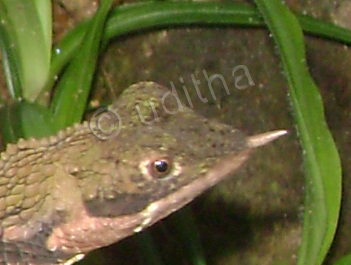
Rhinoceros Horned Lizard - Ceratophora stoddatii

Thread work at Gethampana


Description of a Circunzenithical Arc

A circumzenithal arc is a fascinating atmospheric phenomenon, sometimes called a reverse rainbow, because at first glance it does indeed resemble a backwards or upside-down rainbow. Many observers miss out on circumzenithal arcs, because they are located directly overhead; astronomers cite the circumzenithal arc as another reason for people to look up more, as if the stars weren't enough. Unlike a rainbow, which appears opposite the sun, a circumzenithal arc is centered around the zenith of the sky, and can only appear if the solar angle is less than 32 degrees. 

In order for conditions to be right for a circumzenithal arc to form, small, flat, six sided ice crystals must be suspended high in the sky to create a field of tiny prisms. The sun's rays enter the ice crystals and reflect through them, projecting an arc in the sky which, if complete, would circle the zenith. Completely circular circumzenithal arcs are rare, however; most of them only take up a section of the sky, looking like a smile looking down from the heavens. The circumzenithal arc will remain until the solar angle changes, unless weather conditions change dramatically.    http://www.wisegeek.com/what-is-a-circumzenithal-arc.htm

Physics; how light behaves in a Circumzenithal Arc [CZA]
 
The CZA is produced by oriented plate crystals, the same crystals that form sundogs.
Down coming sunrays enter the uppermost horizontal face and leave through a vertical side face. The refraction of rays nearly parallel rays through faces inclined at 90° produces very pure and well separated prismatic colors. The colors of the circumzenithal arc are purer than those of the rainbow.
When the sun is higher than about 32.3°, the rays cannot leave the side face but are instead totally internally reflected. They then eventually emerge through the lower horizontal face to contribute to the almost devoid of color parhelic circle.
 http://www.atoptics.co.uk/halo/czaform.htm

Light behavior on the so called Ira Sevaya, giving an optical illusion of the up down movement of the sun depicting veneration of the Sacred Mount. 


Aditha my journalist niece who listened to this story thought it was worth going public. www.dailynews.lk/2011/05/20/fea21.asp